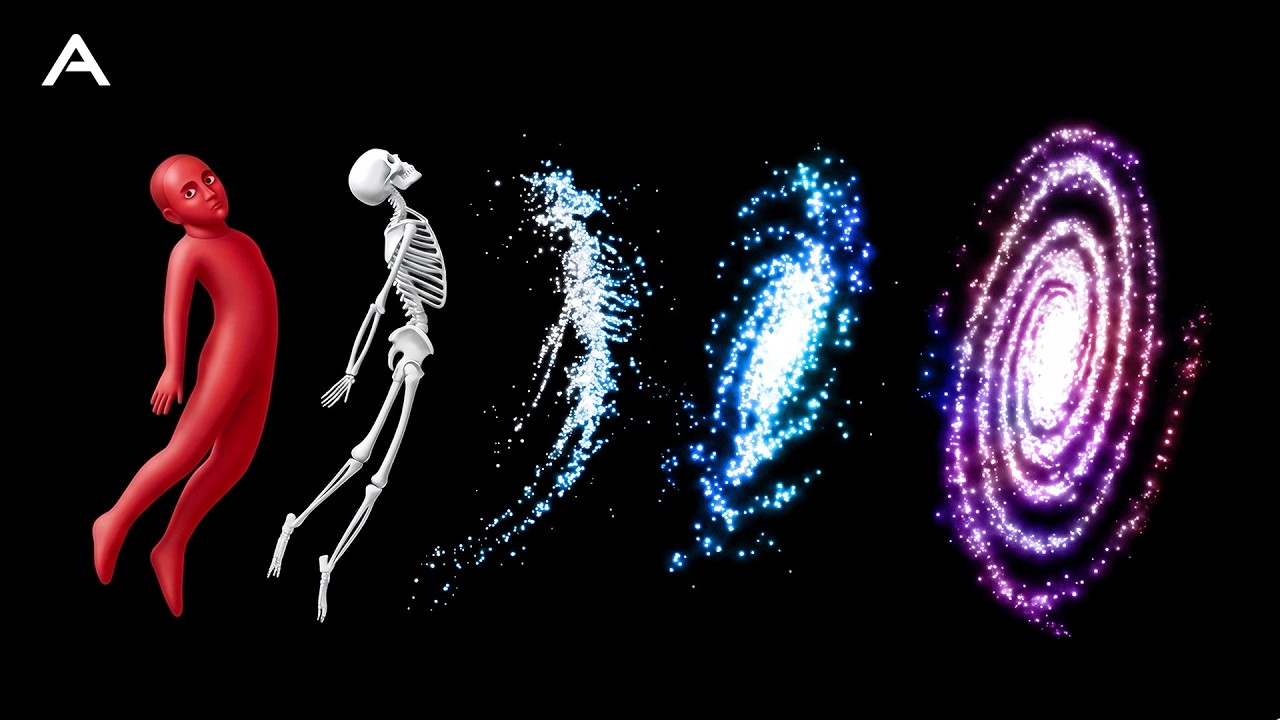
At a glance
Light has no mass. Not a small mass, not a mass too tiny to matter, zero. And yet starlight visibly bends around the Sun, galaxies split single quasars into four copies, and a black hole carves a silhouette out of the sky. Sleep On Physics spends one hour and forty eight minutes taking that contradiction apart, patiently, in the order a person actually needs to hear it, and the resolution is not a loophole. It is a demolition. Gravity is not a force that grabs mass. Gravity is the shape of spacetime, and light follows the shape because everything follows the shape.
The argument is built as a proof, not a tour. First it establishes that a photon genuinely has zero rest mass while still carrying energy and momentum, because the real energy relation is not the Newtonian one. Then it sharpens the paradox to a point using Newton's own law, where zero mass means zero force and light should sail past every star undisturbed. Then it produces the evidence that this is flatly false: May 29, 1919, a total eclipse, two British expeditions, and a measured deflection of 1.75 arcseconds, exactly twice what any Newtonian fudge could deliver. The factor of two is the whole story, and the video refuses to let it go until you understand where the missing half comes from.
What follows is the repair. Einstein's happiest thought, the equivalence principle, the sealed elevator, geodesics, the three classes of spacetime separation, and the specific claim that a photon travels a null geodesic at exactly the local speed of light for every step of a journey that looks curved only from far away. Half the deflection comes from curved space, half from curved time, and Newton had neither. Then the video walks the evidence: GPS clocks, Mercury's perihelion, LIGO, the Shapiro delay, Pound and Rebka in a Harvard stairwell, and finally the whole observed sky, microlensing, Einstein rings, the Bullet Cluster, a supernova whose reappearance was predicted a year in advance and delivered on schedule, and the shadow of a black hole.
The line the video keeps returning to, and earns: the photon is straight, the road is bent.
The strangest fact in physics, stated cold
The opening does not ease in. Light has no mass, zero, and photons always travel at the same speed no matter what you do to them. And yet when light passes near a star it bends. Near a galaxy it curves. Grazing the edge of a black hole it can be deflected, distorted, split into multiple copies, or wrapped completely around into a ring.
This should not happen. Gravity as most people learn it is a force that pulls on things with mass. So how can gravity pull on something that has no mass at all? How can a force reach out and grab something that has nothing to grab?
That is the question, and the narrator promises that by the end you will understand not just how light manages to bend, but why it must.
The photon: zero rest mass is not an approximation
Start with a photon. Not a metaphor for a photon, not a wave, not a beam. A single individual particle of light. If you could hold one in your hand, which you cannot, you would find it has no rest mass whatsoever.
This is worth being precise about, because people assume "massless" is shorthand for "very light." It is not. The experimental upper limit on the photon's rest mass sits at something like 10-54 kg, and even that number is only a limit, not a measurement. As far as every experiment ever conducted can tell, a photon truly has zero rest mass. It is one of the few particles in nature that carries this strange, austere property.
And yet that same photon carries energy. It carries momentum. It exerts pressure when it strikes an object. It knocks electrons free from a metal surface. It pushes on a solar sail well enough to accelerate a spacecraft. Sit in the sun and the light hitting your skin is not just warming you, it is ever so gently pushing you. That push is real, it has been measured with delicate laboratory instruments, and it is used every day in technologies from spectroscopy to laser cooling.
So the first strange fact is on the table before we have even reached gravity. Something with no rest mass can still carry energy and can still exert force.
What a photon actually is
A photon is the quantum of the electromagnetic field. That is a technical way of saying that light, when you look closely enough, is not a continuous stream. It comes in discrete packets, tiny individual bundles of electromagnetic disturbance.
Each bundle carries a specific amount of energy, and that energy depends only on the frequency. A photon of blue light carries more energy than a photon of red light. Ultraviolet carries more still. A radio photon carries very little at all.
But every one of these photons, whatever its color, travels through empty space at exactly the same speed: roughly 300,000 km/s. And the video is careful with the framing here, because it matters later. That speed is not just a fast speed. It is the invariant speed of the universe, the speed woven into the geometry of spacetime itself. Every photon travels at it, and has always traveled at it, from the moment of its creation to the moment of its absorption. A photon cannot slow down. A photon cannot speed up. It can only exist while it is moving at the speed of light.
Momentum without mass
Here is where school physics starts to fail you. In the physics most people learned, momentum is mass times velocity. Heavier object at the same speed, more momentum. Same mass moving faster, more momentum. So how can a photon with zero mass carry any momentum at all? Zero times any speed is still zero.
And yet the momentum of light is real, and measured. It is why comet tails point away from the Sun, pushed outward by the pressure of sunlight streaming through the solar system.
The resolution is that the Newtonian formula was never the full relationship. The real one connects three quantities:
E² = p²c² + m²c⁴
The energy of a particle squared equals its momentum squared times the speed of light squared, plus its rest mass squared times the speed of light to the fourth power. The narrator explicitly does not ask you to memorize it. What matters is what happens when you set the rest mass to zero.
The whole last term vanishes. What is left is beautifully simple:
E = pc or, rearranged, p = E/c
Which means, and this is the key, a photon can carry momentum precisely because it carries energy. It does not need mass to have momentum. Energy alone is enough.
Once you accept that momentum is not the exclusive property of things with mass, the door begins to open. Photons are not passive glimmers of nothing. They are physical entities with real physical properties, participating in the physics of the universe in ways that go well beyond the mass and force picture most of us grew up with.
Newton's picture, and exactly where it breaks
Now the puzzle, sharpened.
Isaac Newton in the late 1600s gave humanity a description of gravity that worked so well and for so long that it dominated science for over two centuries. In Newton's picture, gravity is a force. It reaches out across empty space and pulls on objects. The strength of that pull depends on two things: how much mass the pulling object has, and how much mass the pulled object has. Double either mass and the force doubles.
If either mass is zero, the force is zero.
That last sentence is where the trouble lives. In Newton's picture, if you have no mass, gravity has no way to grip you. There is no force because there is nothing for gravity to act on. A photon with no rest mass should feel no pull from any star, no pull from any galaxy, no pull from anything at all. It should sail through the universe in a perfectly straight line, forever undisturbed by the gravitational field of every massive object it passes.
That is not what we see.
May 29, 1919: the day it stopped being a debate
The moment this became public knowledge, the moment it became indisputable, has a date attached to it.
A total solar eclipse crossed the Atlantic and passed over parts of Africa and South America. Two teams of British astronomers positioned themselves along the eclipse path with careful instructions: one led by Arthur Eddington on the island of Príncipe off the west coast of Africa, another stationed at Sobral in Brazil.
Their task was to photograph the stars that appeared near the Sun during the brief minutes when the Moon blocked the Sun's blinding disc, then compare the positions of those stars in the photographs to their known positions in the night sky when the Sun was somewhere else entirely.
The prediction under test was Einstein's. Four years earlier, in 1915, he had completed his general theory of relativity, a new theory of gravity that made a very specific claim. Starlight passing near the edge of the Sun should be deflected by a tiny but measurable angle: about 1.75 arcseconds.
That is a truly small angle. An arcsecond is one 3600th of a degree. 1.75 arcseconds is roughly the angular size of a small coin viewed from a couple of kilometers away. But it was measurable, and crucially it was exactly twice the deflection you would predict if you tried to treat light as a stream of tiny massive particles being pulled by Newton's gravity.
When the plates came back and the measurements were made, they matched Einstein, not Newton. The starlight had been deflected by very close to 1.75 arcseconds, and the deflection was real. The next morning, newspapers around the world carried the story and Einstein became a household name almost overnight.
But underneath the fame, the science was doing something quiet and enormous. It was announcing that light, which has no rest mass, is nonetheless bent by gravity, and that the amount of bending is not what any straightforward Newtonian calculation could give you.
The Newtonian half answer, and how you even get one
There is an obvious objection sitting in that story, and the video does not skip it. If Newton's gravity really does say a massless photon feels no pull, how does anyone do a Newtonian calculation of light deflection at all?
The honest answer is that people did it by pretending. Going back as far as the 1700s, they imagined light was made of tiny particles with some small unknown mass, and cranked through Newton's equations to see how much such particles would be deflected passing near the Sun or a planet.
And when you do that calculation, something interesting happens. The mass of the light particle drops out of the answer entirely. The predicted deflection depends only on the mass of the star and how close the light passes. So you get a specific number for the bending, even though you started from an assumption you cannot really justify.
That number, for a ray grazing the Sun, is about 0.87 arcseconds. Exactly half of what Einstein predicted, and exactly half of what 1919 measured.
Two centuries of people asking the right question with the wrong tools
The Newtonian half answer, meager as it is, has a surprisingly long history, and the video spends a genuinely lovely stretch on it. The idea that gravity might bend light did not begin with Einstein. It did not even begin in the 20th century. It goes back to Newton himself.
In the final pages of Opticks, published in 1704, Newton posed a series of questions, 31 of them in the later editions, meant to stir thought rather than assert doctrine. In the very first of those queries he asked whether bodies did not act upon light at a distance, and whether that action might be by bending its rays. It was a passing thought expressed as a question, not a prediction. But it planted the seed. Newton, whose gravity insisted only mass could feel mass, was already wondering whether light might not be exempt.
The seed took nearly a century to germinate. In 1783 an English clergyman and natural philosopher named John Michell, working from a Yorkshire rectory, sat down and did something extraordinary. He asked what would happen if you took a star and made it larger and larger, or denser and denser, until the escape speed from its surface equaled the speed of light. Escape speed is the speed a projectile needs to leave a body's gravity forever, and Michell computed it using Newton's own equations, treating light as most people then did, as a stream of tiny corpuscular particles.
What he found was that for any given density there exists a size beyond which no light could escape. Such a body would appear black, invisible from a distance, even though it might be extraordinarily massive. Michell called these objects dark stars. He wrote about them in a letter to the Royal Society, read aloud in London to an audience that mostly forgot about it.
This was, in every essential sense, the first published prediction of an object we would today call a black hole. Arrived at more than a century before Einstein's field equations existed. It was based on Newtonian gravity and a corpuscular theory of light, both of which turned out to be incomplete. And yet the qualitative answer, that gravity strong enough could trap light, was right. The universe would eventually confirm it, not in the way Michell imagined, but in a way that echoed his intuition.
A few years later, in 1796, the great French mathematician Pierre-Simon Laplace independently arrived at nearly the same conclusion, describing similar dark bodies in his popular Exposition du système du monde. Laplace removed the discussion from later editions once the wave theory of light became dominant, since a wave theory made the corpuscular calculation feel outdated. But the idea had now been aired twice by serious thinkers, based on nothing more than Newton's gravity and a willingness to imagine that gravity might act on light.
Then in 1804 a German astronomer named Johann Georg von Soldner published a calculation of a subtler effect. Not the trapping of light by an infinitely dense body, but the mere bending of light by an ordinary star. Soldner, treating light as a stream of tiny particles moving at the enormous but finite speed of light, computed how much a light ray grazing the Sun would be deflected by the Sun's gravity.
He got 0.87 arcseconds. This is exactly the Newtonian half answer. Soldner arrived at it 115 years before Eddington's expedition, working from purely Newtonian assumptions and thinking of light as small massive corpuscles. His paper was published in a respectable astronomical journal. It was then almost entirely ignored, because the wave theory of light was taking over, and if light was a wave it was not obvious what it meant to say gravity was acting on individual corpuscles of it.
The unfortunate afterlife of Soldner's paper
Soldner's calculation drifted into obscurity for a full century, and surfaced again only after Einstein's prediction became famous. It surfaced in an ugly way. In the wake of the 1919 result, a small number of anti Einstein figures in Germany dug up Soldner's paper and tried to argue that Einstein had merely rediscovered what Soldner had already done.
This was untrue, and the video is blunt about why. Soldner had computed the Newtonian half of the deflection using an assumption, that light is made of massive corpuscles, which Einstein explicitly did not need. Einstein's prediction was different in origin and different in magnitude. It arose from a theory that treated gravity as geometry, and it produced twice the deflection Soldner had gotten. The 1919 measurement did not confirm Soldner. It ruled him out.
But the historical footnote is still worth remembering, because it tells us something honest about the century leading up to Einstein. People had been wondering whether light bent under gravity for a long time. They had been calculating, in a Newtonian way, what the answer might be. They had even been imagining objects so gravitationally strong that light could not escape them. What they lacked was a framework that made these speculations rigorous. What they lacked was general relativity.
Einstein did not invent the question. He answered it correctly, using a picture of the universe no one before him had built.
There is a lesson buried in this, and the narrator states it plainly. When a question is a real question, a question that reality actually has an opinion about, it tends to occur to people over and over across the centuries. Newton wondered. Michell computed. Laplace repeated. Soldner published. None of them had the tools to close the loop. And so for 215 years the question of whether light bent under gravity sat as an open speculation on the edge of physics, until a set of equations existed and Eddington sailed to a small volcanic island in the Gulf of Guinea and photographed a total eclipse through drifting clouds from a plantation clearing.
Two hundred years of ancestral guesses, settled by a set of photographic plates.
- 1704Newton's Query 1. In the closing pages of Opticks, Newton asks whether bodies act upon light at a distance and bend its rays. A question, not a claim.
- 1783Michell's dark stars. A Yorkshire clergyman computes that above a certain size for a given density, escape speed exceeds the speed of light and the body would appear black. The first prediction of a black hole, 132 years early.
- 1796Laplace repeats it. Independently describes the same dark bodies, then quietly deletes the passage from later editions as the wave theory of light takes over.
- 1804Soldner computes 0.87″. The Newtonian half answer for a ray grazing the Sun, published and then ignored for a century.
- 1905Special relativity. The invariant speed of light becomes a structural fact about the universe rather than a property of light.
- 1907The happiest thought. At the patent office in Bern, Einstein realizes a freely falling person feels no gravity at all.
- 1915General relativity completed. Gravity is geometry. Predicted solar deflection: 1.75″, exactly twice Soldner.
- 1919The eclipse. Eddington at Príncipe and a second team at Sobral photograph stars beside the eclipsed Sun. The plates favor Einstein.
- 1959Pound and Rebka. Gravitational redshift measured over 22.5 m of a Harvard stairwell, a shift of 2.5 parts in 1015.
- 1964Two proposals. Irwin Shapiro proposes the radar time delay. Sjur Refsdal proposes using a lensed supernova to measure the cosmos.
- 1979The Twin Quasar. Two quasars turn out to be one quasar, split by a foreground galaxy. Strong lensing confirmed in the sky.
- 2015Two arrivals. LIGO detects gravitational waves on September 14. On December 11 the predicted reappearance of Supernova Refsdal shows up on schedule.
- 2019The shadow. The Event Horizon Telescope publishes the first image of a black hole's shadow, M87*.
- 2022Earendel and Sgr A*. A single star at 12.9 billion light years, magnified by a cluster. And the shadow of the Milky Way's own black hole.
The puzzle in its final form
So the Newtonian half answer is wrong in two ways at once. It is wrong on principle, because it assumes light has mass when it does not. And it is wrong in magnitude, because even that shaky answer comes out to only half the observed value. Somewhere in the physics, something more is happening. Something Newton did not see and could not see from where he was standing in the 17th century.
Stated as sharply as it can be stated:
- Light has no rest mass.
- Newton's gravity says only mass feels gravity.
- Therefore light should not be bent.
- But light is bent, and bent by exactly twice as much as any generous Newtonian fudge would allow.
There is a mystery here that will not go away no matter how hard we squint at it. And solving it requires us to give up something that feels obvious about the world, something that feels as solid as the ground under your feet. It requires us to give up the idea that gravity is a force at all.
Gravity is not a force, and one thought proves it
That sentence probably sounds wrong. Gravity feels like a force. It pulls you into your chair right now. It holds the Moon in orbit and drags apples toward the ground. Everything about lived experience insists that gravity is something reaching out and pulling. The video's claim is that this feeling, powerful as it is, is one of the great optical illusions of the human condition, and correcting it is exactly what allows massless light to bend without contradiction.
The person who saw through the illusion more clearly and more completely than anyone before him was Einstein, and he did not start with mathematics. He started with a thought.
In 1907, two years after publishing his special theory of relativity, Einstein was sitting at his desk in the patent office in Bern, Switzerland, when a simple image occurred to him. He later called it the happiest thought of his life.
Imagine a person falling freely off the roof of a house. During the fall, if that person releases an object from their hand, the object does not fall away from them. It hovers right beside them, motionless from their point of view, because both the person and the object are falling together, subject to the same gravitational pull. The person, while falling, feels no weight at all. There is no floor pushing up on their feet. There is no force detectable anywhere inside their body. As far as their own experience goes, gravity has vanished.
Einstein realized this was not a curiosity. It was a signpost.
If a freely falling observer feels no gravity, then gravity cannot be a fundamental force the way electricity and magnetism are fundamental. An electric charge that is falling still feels electric forces. A magnet that is falling still feels magnetic forces. But gravity, whatever it is, has this peculiar property that you can make it disappear entirely just by letting yourself fall. That is not how a proper force behaves. That is how something else behaves. Something more like a description of the frame you are looking from.
The equivalence principle and the sealed elevator
From that seed Einstein developed what is now called the equivalence principle. It comes in a few flavors, but the heart of it is a single scenario.
You are inside a sealed elevator with no windows. You cannot see outside. Someone drops a ball and it falls to the floor. From that observation alone, can you tell whether the elevator is sitting still on the surface of a planet, or whether it is out in deep space, far from anything, being accelerated upward by a rocket engine at exactly the right rate?
The astonishing answer is no. You cannot tell. The two situations are physically equivalent. Every experiment inside the elevator gives the same result whether you are being accelerated by a rocket or standing still on a world. Gravity, in a small enough region, is indistinguishable from acceleration.
Now think carefully about what that means for light.
Suppose the elevator is out in deep space, accelerating upward, and a beam of light shines in through a small hole in one wall, aimed perfectly horizontally, straight across toward the opposite wall. In the frame of someone outside watching from the depths of space, the light travels a perfectly straight line. But the elevator, during the fraction of a second the light takes to cross, is accelerating upward. By the time the light reaches the far wall, the elevator has moved. So the light strikes the far wall slightly lower than the point directly across from where it entered. Inside the elevator, from the passenger's point of view, the light appears to have bent downward, as if it were falling.
That is inside a rocket in deep space, where there is no gravity at all, only acceleration.
If the equivalence principle is right, then inside a stationary elevator on the surface of a planet, where gravity is present but there is no acceleration, light must also bend downward. Otherwise the two situations would be distinguishable and the equivalence principle would be false.
So from this thought experiment alone, before writing a single field equation, Einstein could already conclude that light must be deflected by gravity, massless or not.
That was the crack in the old picture. From that crack, over the next eight years, Einstein built an entirely new theory of gravity. He called it general relativity because it generalized his earlier work on special relativity to include gravity and acceleration.
Gravity is geometry
The central claim of general relativity is one of the most beautiful and strangest ideas in all of science, and the narrator says it twice on purpose because it deserves to be sat with.
Gravity is not a force. Gravity is geometry.
What we experience as gravitational pull is not something reaching out and grabbing us. It is a change in the shape of the arena in which we exist, in which everything exists. That arena is spacetime, and its shape is molded by the presence of mass and energy.
Space and time, which we normally think of as separate things, are actually woven together into a single four dimensional fabric. Three dimensions of space, one of time, all stitched together. In the absence of matter or energy this fabric is flat and smooth, like an infinite calm sea. Objects moving through it travel in straight lines, following what physicists call geodesics. In a flat, empty region of spacetime a geodesic is exactly what you would call a straight line in the ordinary sense. A rock drifting in deep space with no forces on it travels along one of these forever. So does a photon. So does anything else moving freely.
But mass and energy change the shape of the fabric. They warp it. They curve it. Around a planet, spacetime is bent. Around a star, more strongly. Around a black hole, so severely that its geometry becomes almost incomprehensible. And in a curved region, the geodesics, the straightest possible paths through that region, are no longer what we would draw as straight lines on a flat sheet of paper. They are the closest thing to straight that the warped geometry allows.
The rubber sheet, and why you should hold it loosely
The most common way this idea gets illustrated is with a rubber sheet. Stretch a big flat sheet tight, put a bowling ball in the middle, and the sheet sags into a curved depression. Roll a marble across it and the marble does not travel straight, it curves as it approaches the ball. Push it the right way and it will orbit, going round and round in the depression before spiraling in.
The video uses the picture and then immediately, and refreshingly, dismantles it, because it wants to be honest about what the analogy costs:
- The rubber sheet is a two dimensional surface curving in a third dimension. Real spacetime is a four dimensional structure that curves without needing any higher dimension to curve into.
- The rubber sheet needs gravity to work. The ball sinks and the marble orbits because there is real gravity underneath the table. It is using gravity to explain gravity, which is a kind of cheating.
- The rubber sheet shows only the curvature of space, not the curvature of time. And for weak gravitational fields, the curvature of time is actually the more important of the two.
So keep the rubber sheet if it helps, but hold it lightly. The real picture is stranger. Space and time both bend together in ways no two dimensional model can capture.
What it means to say that time bends
Here is one way to grasp it. Time near a massive object runs more slowly than time far away from it. This is not a matter of clocks being confused. It is a real, measured effect.
Put one atomic clock at the bottom of a tall building and an identical clock at the top. After enough time has passed, the two disagree. The clock at the bottom, closer to the center of the Earth, will have ticked fewer times. The clock at the top will have ticked more. Time itself flowed at slightly different rates at the two heights.
The effect has been measured so precisely that the global positioning satellites overhead must correct for it constantly. If they did not, the maps on your phone would drift by kilometers within hours.
And here is the stunning consequence, the one that makes the whole geometric picture click into place. If time flows more slowly deeper in a gravitational well, then a freely moving object with no forces on it at all will naturally be drawn toward that region. Not because there is a force sucking it in, but because in curved spacetime the straightest possible path is the one that spends more time where time flows more slowly.
That is what a geodesic does. It maximizes proper time, the time actually experienced along the path. And near a massive object, the geodesic that maximizes proper time is one that curves inward toward the mass.
This is why apples fall. It is why the Moon orbits. It is why you are sitting in your chair right now. Not because gravity is pulling you down, but because the geometry of spacetime near the Earth is such that the straightest path through it, for you, is one that would take you toward the center of the planet.
The chair is the thing accelerating you
That leads to a dizzying reversal of the ordinary picture, and the video lingers on it because it is the point where the geometric view stops being abstract.
The chair is not stopping you from falling. The chair is pushing you off the geodesic you would otherwise be following.
When you are standing still on the ground, you are not at rest in any deep physical sense. You are accelerating. The ground is pushing up on your feet, forcing you away from the path you would take if you were free. If you jump off a diving board, during those brief seconds of free fall before you hit the water, you are the one who has stopped being pushed. You are moving along your natural geodesic, and it is only the pool at the bottom that will interrupt it.
Same for the astronaut floating inside the space station. That is not the absence of gravity, whatever popular language says. The astronaut is falling around the Earth along a geodesic, and inside the station the same geodesic passes through them and everything they can see. Nothing has weight, not because gravity is gone, but because of the presence of pure uninterrupted geodesic motion.
Two walkers leaving the equator
To make curvature concrete, the video gives its cleanest analogy, and it costs nothing in accuracy.
Two people start at the equator some distance apart, and both walk due north along their respective lines of longitude. Both are walking in what feels to each of them like a perfectly straight line. Neither turns. Neither steers.
And yet, watched from a satellite above, the distance between them is shrinking. As they walk northward they get closer and closer, and by the time they reach the north pole they are standing side by side. They meet, even though neither of them ever consciously walked toward the other.
No force drew them together. The surface of the Earth is curved, and two straight paths on a curved surface can converge. That is what geodesics do in curved geometry: straight paths, followed faithfully, curve as seen from outside.
And that is exactly what happens to freely moving objects, and to photons, in the curved spacetime around a massive body.
The moment mass disappears from the argument
This is the hinge of the entire video, and it is worth reading slowly.
Notice that the whole discussion about mass has quietly vanished from the description.
A geodesic is a geometric object. It is defined entirely by the shape of the region it passes through. Which geodesic you follow does not depend on your mass, or on the mass of anything else. It depends only on your starting position and your starting direction of motion. If you are massive, you follow it. If you are massless, you also follow it. The geometry does not care.
Anything moving freely through a region of spacetime follows the geodesics available in that region. And in a region curved by the presence of a nearby star, those geodesics are curved paths. Which means a photon passing near that star will be deflected. Not because gravity is pulling on its mass, because it has no mass, but because the road it is traveling on is bent.
Where the missing half was hiding
And here is where the Newtonian picture, generous as we tried to make it, was falling short by a factor of two.
In Newton's world, only space matters. If you compute the deflection of light by imagining photons as massive particles pulled sideways as they whip past the Sun, you get the deflection that comes purely from the curvature of space.
But in Einstein's world, spacetime is what curves. Both space and time. And near a slowly moving, weakly gravitating body, the two contributions matter equally.
Half the deflection comes from the fact that space itself is curved near the star. The other half comes from the fact that time flows differently near the star. Add both together and you get exactly 1.75 arcseconds for light grazing the edge of the Sun. Twice the Newtonian half answer. Exactly what the 1919 eclipse measured. Exactly what a century of ever more precise observations has continued to confirm.
| Newton | Einstein | |
|---|---|---|
| What gravity is | A force reaching across space, pulling on objects | The curvature of a four dimensional spacetime |
| What gravity acts on | Mass. No mass, no force. | Nothing. Objects follow the geometry they are already in. |
| What sources it | Mass alone | Mass, energy, momentum, pressure and stress, packaged as the stress energy tensor |
| Can massless light bend? | Not in principle. Only by pretending light has a tiny mass, which then cancels out of the answer. | Necessarily. Light is freely moving, so it follows geodesics like everything else. |
| Deflection at the solar limb | 0.87″ (space curvature only, and only via the fudge) | 1.75″ (half from curved space, half from curved time) |
| Verdict of 1919 | Ruled out | Confirmed |
| Status today | An excellent approximation in weak fields at slow speeds. It still gets you to the Moon. | Untouched by any test at any precision anyone has reached. |
The question was wrong
Look at what has happened in the argument. We asked how gravity can bend something with no mass. The answer, once you follow it all the way, is that gravity does not bend anything. Gravity is not doing the bending. The bending happens because the geometry of spacetime is curved, and everything, mass or no mass, follows the shape of the geometry.
The question we started with, how can gravity grab something massless, was the wrong question. Gravity does not grab. Gravity is the shape of the space through which grabbing would happen.
Once you see this, the paradox dissolves. Not because we found a hidden way for photons to have mass, but because we let go of the idea that mass was ever required for gravity to matter.
The best way to check a picture is to see what else it predicts
And this is where general relativity has its most impressive record. In the century since Einstein completed the theory, essentially every prediction it makes has been confirmed, often to spectacular precision. The bending of light was one. There were others just as striking.
Gravitational time dilation. The atomic clocks aboard the global positioning satellites tick faster than the ones on the ground by about 38 microseconds per day, a combination of two relativistic effects working in opposite directions. If those corrections were not applied, the positions computed from those satellites would be wrong by roughly 10 km within a single day, and global navigation would be useless. The fact that it works is a tribute to general relativity, tested every second of every day by billions of devices.
The precession of Mercury's orbit. For centuries astronomers had noticed that the point where Mercury swings closest to the Sun, its perihelion, drifts a tiny amount from one orbit to the next. Most of that drift is explained by the gentle gravitational tugs of the other planets. But there was a residual, unaccounted for drift of about 43 arcseconds per century. In the 19th century this was such a stubborn mystery that some astronomers postulated an entire undiscovered planet closer to the Sun than Mercury and gave it a name: Vulcan. Vulcan did not exist. General relativity, applied to Mercury's orbit, predicted a precession of 43 arcseconds per century arising purely from the curvature of spacetime near the Sun. Exactly the missing amount. Einstein wrote later that when he saw the equations work out, his heart pounded for days.
Gravitational waves. General relativity predicts that when massive objects accelerate they send ripples of spacetime curvature outward across the universe, traveling at the speed of light. For a century these were purely theoretical. Then on September 14, 2015, two enormous detectors, one in Louisiana and one in Washington state, the Laser Interferometer Gravitational Wave Observatory, picked up a signal. It was the merger of two black holes more than a billion light years away, spiraling into each other and colliding. The signal was a stretching and squeezing of spacetime itself on the order of one part in 1021, less than a thousandth the width of a proton across the detector's 4 km arms. And the detectors found it. The pattern matched general relativity so precisely that it was, in effect, a direct measurement of curved spacetime doing exactly what Einstein said it would do.
So gravity as geometry is not a speculative reinterpretation of the old picture. It is the one reality confirms again and again, whenever we test carefully enough to tell the two apart. Newton's gravity remains an excellent approximation in weak fields and at slow speeds. It gets you to the Moon just fine. But it is an approximation, and the truth underneath it is curved spacetime.
Light is still special: the three kinds of separation
We now have the reframing. Gravity is geometry, mass and energy warp spacetime, freely moving objects follow the straightest paths available, and light is a freely moving thing traveling through spacetime, so it follows the geometry too.
But the question sharpens. What kind of path exactly does light follow? Because massive objects and massless objects, it turns out, do not travel through spacetime on quite the same kinds of roads.
To see why, go back to the fact that seemed almost mystical when we first met it. The speed of light is not merely fast, not merely constant, but invariant. It is the same for every observer no matter how that observer is moving. Stand still and measure a passing beam: 300,000 km/s. Jump on a rocket, chase the beam at half the speed of light, measure again: still 300,000 km/s. Slow down and let the beam catch you: still 300,000 km/s. There is no way to catch light and no way to escape it. It always passes you at the same speed.
Now bring that fact into the geometric picture. Spacetime has a way of measuring the separation between events, between the ticking of one clock in one place and the ticking of another clock somewhere else. Ordinary geometry on a flat sheet measures distance between two points with a squared difference formula, the one you may remember from school. The spacetime version is similar in spirit but it treats space and time differently: space contributes positively to the separation, time contributes negatively, and the speed of light acts as the exchange rate that converts one into the other.
The upshot is that pairs of events fall into three families, sorted by the sign of the separation between them.
- Timelike. Two events close enough in space and far enough apart in time that a slower than light object could travel between them. That is the separation between two beats of your own heart. Your heart is nowhere near the speed of light, and yet the beats connect.
- Spacelike. Two events so far apart in space and so close in time that not even light could cross between them. Two people snapping their fingers at the same instant on opposite sides of the Earth. No signal, no influence, nothing can pass between them in that zero interval.
- Null, also called lightlike. The knife edge in between, where the two events are exactly balanced such that a beam of light traveling at the invariant speed could just barely go from one to the other.
That word null does not mean nothing. It means zero. The spacetime separation between the beginning and end of a photon's journey, in the geometric language of general relativity, adds up to exactly zero. Space contributes something. Time contributes an equal and opposite something. The two exactly cancel. This is how relativity encodes the fact that light always travels at the invariant speed: the path of a photon through spacetime is a path along which the total spacetime interval is zero, every step of the way.
Three kinds of geodesic
So when we talk about geodesics, straightest paths through curved spacetime, we have to be more careful than we were before. There is not one kind of geodesic. There are three: timelike, spacelike, and null.
Massive objects moving slower than light follow timelike geodesics. Photons moving at the invariant speed follow null geodesics. Spacelike geodesics are geometric curves that no physical object can travel along, because doing so would require going faster than light.
Light and matter live on different roads, even when moving through the same neighborhood.
This clears up something otherwise confusing. When we say a photon follows the straightest path through a curved region, we are not saying it follows the same path a slow moving rock would follow if the rock started from the same place going the same direction. It does not. The photon follows a null geodesic, the rock follows a timelike geodesic. They can pass through the same point in the same direction and still end up on entirely different curves, because the geometry sorts them into different classes based on their speed. A photon, condemned by its nature to always move at exactly the invariant speed, has no choice but to follow the null path available to it.
Locally, always exactly c
Now the fact at the heart of the whole story. Even in curved spacetime, even in the fierce warp near a star, a photon locally always moves at exactly the speed of light.
That word locally matters. If you are floating right next to the photon, watching it whip past you in a region of space and time small enough that you can pretend the geometry is flat, you will always see it moving at 300,000 km/s. It never slows down. It never speeds up. It is not, as some popular descriptions carelessly say, dragged around by gravity like a marble on a curved surface. It is racing at the invariant speed the whole time.
It is only the road that is bent.
The subtlety that trips people up: the Shapiro delay
There is a trap here and the video walks straight into it on purpose.
People hear that clocks run slower in strong gravitational fields and infer that light must therefore travel more slowly there too. From a certain distant vantage point, this is actually true. If you sit far from a massive object and describe the motion of a light ray that passes close to it using the coordinates of your own faraway rest frame, the light will appear to move more slowly during the part of its journey closest to the mass.
This is the Shapiro delay, and it has been measured. Radar signals bounced off Venus and other planets, when the signal passes near the Sun, take a tiny bit longer to make the round trip than they would in the absence of the Sun's gravitational field. The delay is small but real, and it matches general relativity's prediction to superb precision.
But this apparent slowdown is a coordinate effect. It is a statement about how faraway clocks and rulers describe the trip, not about what is actually happening to the photon. The photon, locally, is always moving at the speed of light. It cannot do anything else.
What the Shapiro delay really measures is that the geometry near the Sun is stretched. There is, in a real sense, more spacetime for the photon to cross than there would be in flat space. It takes longer because the trip is longer, not because the photon has slowed down.
This is a case where the geometric picture is doing crucial work behind the scenes. If you cling to the flat space picture and try to interpret every effect as a change in the photon's speed, you will get confused. If you accept that the geometry itself is curved and that photons trace null paths through it at the invariant speed, everything falls into place.
Shapiro's experiment, in detail
The video spends real time here, and it earns it, because this is the experiment that demonstrates the geometric picture in a way you can almost hold in your hand.
It is named for Irwin Shapiro, an American physicist who proposed the effect in 1964. Shapiro pointed out that if the geometry of spacetime near the Sun is really warped, then a round trip radar signal passing close to the Sun should take a measurably longer time than the same signal traveling through nearly flat spacetime. Not because the signal slows down in any local sense, since the signal, made of radio wavelength photons, still moves at the invariant speed everywhere along its path. But because the path itself, described in a coordinate system anchored to the Earth and the Sun, is effectively longer when it dips into the warped region.
He proposed testing it by bouncing radar off Venus and Mercury at moments when those planets were on the far side of the Sun from Earth, so the signal had to pass close to the solar limb on the way out and on the way back. His estimate for the extra round trip delay for a signal grazing the Sun's edge was on the order of 200 microseconds, two hundred millionths of a second added to a round trip time of many minutes.
It sounds like a hopelessly tiny effect. But radar timing is extraordinarily precise. By the late 1960s, using the enormous radio dish at the Haystack Observatory in Massachusetts, Shapiro and his collaborators had measured the delay, and their result agreed with general relativity to within a few percent.
Over the following decades the measurement was sharpened. Radar signals bounced off spacecraft rather than planets gave far cleaner returns, because a spacecraft is a controllable target that echoes with high fidelity. The Viking landers on Mars in the mid 1970s allowed a precision test at the level of one part in a thousand. Then in 2003 a team led by Bruno Bertotti used tracking data from the Cassini spacecraft during its long cruise to Saturn to test the Shapiro delay to a precision of a few parts in 100,000.
General relativity passed. It has never failed this test at any level of precision anyone has yet been able to reach.
Think about what that means geometrically. When we say the round trip radar signal takes an extra 200 microseconds because it passed near the Sun, we are saying in effect that there was more room between the Earth and the far side of the Sun than a Newtonian description would allow. The Sun's mass added spacetime to the trip. Not by slowing the light, by stretching the geometry the light had to traverse. And the excess showed up on our clocks.
This is one of the cleanest possible demonstrations that the picture we built is not an interpretation. It is a description of the actual structure of the universe. The clocks agree. The radar echoes come back late by exactly the amount general relativity says they should.
Pound and Rebka in a Harvard stairwell
The video brings in one more experiment in this same territory, because it is small and elegant and drives home that gravitational time dilation is not a subtle abstraction but a directly measurable fact.
In 1959, at Harvard University, two physicists named Robert Pound and Glen Rebka set up an experiment inside a vertical shaft in the Jefferson Physical Laboratory. The shaft was about 22.5 m tall. At the bottom they placed a source of gamma ray photons emitted by iron atoms. At the top they placed a receiver capable of detecting those photons with extraordinary sensitivity.
Then they asked a question that only became askable in the 20th century. If light climbs upward against gravity, does its frequency shift?
General relativity said yes. The photons emitted at the bottom of the shaft, deep in the Earth's gravitational field, are emitted at a certain frequency according to a clock at the bottom. But by the time those photons arrive at the top, the receiver's clock, higher in the field, is ticking a little bit faster. So the receiver sees the photons at a slightly lower frequency than the source's clock says they were emitted at. This is gravitational redshift, the same effect from a few minutes earlier in a different guise. Time flows differently at different heights in a gravitational field, and light faithfully reports the difference.
The frequency shift for a 22.5 m shaft on the Earth's surface is unimaginably tiny. About 2.5 parts in 1015. That is a shift of two and a half units in a number with fifteen zeros in front of it. It is the kind of number that sounds impossible to measure.
They measured it, with a beautiful trick. The gamma ray photons emitted by their iron source could only be absorbed by identical iron atoms at the top of the shaft if their frequencies matched precisely (the recoilless emission and absorption that makes this possible is the Mössbauer effect, and it is what made the whole experiment feasible). When the incoming photons had been redshifted by their climb, they no longer matched, so they were not absorbed.
To compensate, Pound and Rebka mounted the source on a platform that oscillated up and down at a carefully chosen speed. That gave the emitted photons an ordinary Doppler shift, upward or downward in frequency depending on whether the platform was moving toward or away from the receiver. By tuning the platform's motion they could exactly cancel the gravitational redshift, restore the frequency match, and detect increased absorption at the top. The speed of the platform at which absorption peaked told them the size of the gravitational redshift they had cancelled.
The number matched general relativity. It has been rechecked many times since at ever higher precision. It always works.
Why that little experiment matters so much
The Pound and Rebka result is worth telling because of what it demonstrates in compact form. General relativity, this grand geometric theory of the universe, born of eclipse expeditions and orbiting Mercury and the shapes of galaxies, also predicts correctly what happens to a gamma ray photon climbing a 22 m shaft in a physics building in Cambridge, Massachusetts.
It is true at all scales. It is true in the strong field regime around black holes. It is true in the weak field regime of everyday life.
Which means that when we say light bends because it follows null geodesics through curved spacetime, we are not gesturing at a theoretical structure that only matters far away. We are describing something happening in tiny amounts everywhere, all around us, right now. Light climbs stairwells and is redshifted a hair. Light crosses a room and is bent by imperceptible micro warpings of space. The effects are too small to notice without extraordinary instruments. But they are always there, because the geometry is always there, and light, obedient to what light must be, is always following it.
If gravity bends light, does it also slow it down?
The answer, honestly, is no. Gravity does not need to slow a photon below the local speed of light in order to bend its path. In fact, if it tried to, the photon would refuse. A photon cannot travel below the local speed of light, ever, because that is not what null paths permit.
The bending happens for a completely different reason than the slowing would happen. The bending happens because null paths in curved spacetime are curved when described in any frame that steps back far enough to see them whole. The photon is doing the same thing it always does, moving at the invariant speed along the straightest path locally available. It is the geometry that has changed. And a straight path through a warped landscape, seen from outside, is a curved one.
The ant walking over a hill
Here is the analogy the video uses to close that thought, and it is the cleanest one in the whole hour and forty eight minutes.
Imagine an ant walking in a perfectly straight line along the surface of a hill. From the ant's own point of view it is not turning. It is not steering. It is walking as straight as any ant can walk, and its little ant compass, if it had one, would show that it is going true. But you, watching from above, can see that the ant's path bends as it goes over the crest of the hill and down the far slope.
Both descriptions are correct. The ant really is going straight, in the only sense of straight the ant can access. And the path really is curving, in the only sense of curving that you, watching from outside, can describe. Neither description is an illusion. They are two accurate ways of seeing the same trip through a curved landscape.
That is exactly what happens to light passing a star. From the photon's own point of view, if a photon had a point of view, it would be moving in a perfectly straight line at the perfectly invariant speed. From our point of view, watching from a great distance where spacetime is nearly flat, we see light following a curved path. Both statements are true and no one has to give ground.
The photon is straight. The road is bent.
The shortcut that sounds tidy and is wrong
There is a very common explanation of light bending that the video explicitly steers around, because it causes the most lingering confusion.
The shortcut says: photons have energy, energy is equivalent to mass through Einstein's famous equation, so photons effectively have mass, and gravity pulls on their effective mass, and that is why they bend.
This story sounds tidy. It manages to squeeze the phenomenon back into a Newtonian frame where gravity is a force pulling on mass. And it is not quite right, because it commits us to the wrong picture of how gravity works.
Once you go geometric, once you accept that gravity is the shape of spacetime and that objects follow geodesics because that is what freely moving things do, you do not need to invoke effective mass for the photon at all. The photon has no rest mass. It also does not need any. The bending of its path is a consequence of the geometry it is passing through, not a consequence of some hidden gravitational grip acting on a phantom effective mass.
The narrator's line for it: trying to explain light bending by giving the photon a fictional mass is like trying to explain why cars drive on curved highways by giving them fictional steering wheels that turn themselves. The road is doing the work. Give the photon back its zero rest mass and its invariant speed, and let the geometry take responsibility. That is the honest story.
But light does gravitate, and that is a different fact
There is a related point worth stating clearly, because it shows up in the equations even though it does not rescue the effective mass story.
In general relativity, gravity is not sourced by mass alone. It is sourced by mass, energy, momentum, pressure, and even certain kinds of internal stress. All of these together are packaged into a mathematical object called the stress energy tensor, and it is this whole object that tells spacetime how to curve.
Which means light, which carries energy and momentum, does contribute to the curvature of spacetime around it, however slightly. Light gravitates, in the sense that it can be a source of gravity, even though it has no rest mass.
But this is a separate story from why light itself follows curved paths. It is why light, along with everything else, participates in the geometry of the universe. The story of why any given photon bends is still the story of the geodesic it is on, not the story of some effective mass tugging back.
The mechanism, assembled
Pull all of it together.
A photon is a massless quantum of the electromagnetic field, carrying energy and momentum but no rest mass. It travels at the invariant speed of the universe, locally the same for every observer everywhere. When it enters a region where mass and energy have curved spacetime, it does not slow down. It does not speed up. It does not feel a gravitational force in the Newtonian sense, because there is no such force in the geometric picture.
What it does is follow a null geodesic, the straightest path available through the warped four dimensional fabric. That path, when viewed from far away where spacetime is nearly flat, appears to us as a curve. The amount of bending is set entirely by the shape of the geometry, which in turn is set by the distribution of mass and energy nearby.
No mass on the photon required. No force in the Newtonian sense required. Just geometry, and a photon doing what light always does.
One idea, many phenomena
Once this clicks into place, a whole set of previously separate sounding phenomena reveal themselves as instances of the same thing.
- Light passing a star bends by a small angle, because the star curves the surrounding spacetime slightly.
- Light passing a galaxy bends by a larger angle, because a galaxy curves spacetime more strongly, thanks to its far greater mass.
- Light passing a galaxy cluster can bend by remarkable amounts, because a cluster, with its thousands of galaxies and its enormous halo of dark matter, curves spacetime on a truly grand scale.
- Light passing a black hole can wrap all the way around, sometimes more than once, because near a black hole the curvature is so extreme that null geodesics can wind themselves into loops before escaping.
Every one of these is the same phenomenon. Every one is a photon following its null geodesic through the geometry available to it.
Which half of the geometry does the work
There is one more piece worth adding, because it ties the geometric picture back to something you can hold in your hand. It concerns which part of the geometry does most of the work in the deflection.
When a body is slowly moving and gravitates weakly, general relativity predicts light deflection that is exactly twice the naive Newtonian answer. Half of that deflection comes from the curvature of space and half from the curvature of time.
That factor of two is the fingerprint of general relativity. Newton knew about the curvature of time in only a very rudimentary way, wrapped up inside his single time independent gravitational potential, and he ignored spatial curvature entirely. When you build a full theory that includes both, you get twice the deflection.
Which is exactly why the 1919 eclipse result was so decisive. It was not just that light bent. Newton could arguably accommodate that with enough shoehorning. It was that it bent by twice as much as any Newtonian shoehorning could ever supply. The extra half was the geometric half. The extra half was space itself bending.
For very strong fields, near a black hole for instance, this clean fifty fifty split breaks down and the geometry becomes far more intricate. But for the Sun, for stars in general, for weak gravitational lenses, the split is a useful thing to carry around. When you look at a photograph of stars slightly displaced from their expected positions by the Sun, you are looking at half a picture of space bending and half a picture of time bending, added together into one measurable angle. It is one of those places in physics where an abstract mathematical structure has left a fingerprint you can literally see on a photograph.
Redshift is the same fact wearing a different face
A natural question follows. If light always moves at the local speed of light, and follows null paths, and is not slowed by gravity, then why do we talk about light being redshifted or blueshifted as it climbs out of or falls into a gravitational field? Does a change in frequency not mean something is happening to the photon?
Yes and no. The frequency of the photon does change when measured by different observers at different heights in the field. A photon emitted at a certain frequency near the surface of a massive object will be received at a lower frequency by someone far away.
But this shift is not the photon slowing down. It is the geometry doing exactly what the equivalence principle demanded it should. Clocks at different heights tick at different rates. What was a certain number of oscillations per tick down low becomes a different number of oscillations per tick up high, because the ticks themselves are different. The photon has done nothing but follow its null geodesic at the invariant speed.
The frequency shift is another face of the same geometric fact. Time flows differently in different places, and light, which is nothing if not a rhythm woven through spacetime, faithfully reports the difference.
The full answer, before we go looking
We have now built the full mechanism.
Light has no rest mass and needs none. It carries energy and momentum by virtue of its motion at the invariant speed. When it enters curved spacetime it follows the straightest null path available, still at the invariant speed locally, still without being pulled by anything in the Newtonian sense. Seen from outside, that path is curved. Seen from up close, everything about the photon is exactly what it always was.
This is why light bends around gravity even though it has no mass: because it was never mass that gravity acted on. It was geometry that light followed.
Everywhere in the universe where gravity is strong enough to notice, we can now expect to see this effect at work. And when we go looking, that is exactly what we find.
Reading the sky like a text
The second half of the video steps outside the theory and looks at what the universe has been doing with this mechanism all along. Once you know that light follows the geometry of spacetime, and that mass and energy shape the geometry, you can begin to read the sky like a text written in that language.
The universe is full of gravitational lenses. Some are subtle, showing themselves only when astronomers analyze millions of galaxies together. Some are so dramatic that a single photograph shows arcs and rings and duplicated galaxies scattered across the field like a hall of mirrors. All of them are the same phenomenon we spent the last hour building: light following its null geodesics through curved spacetime.
There is no new physics from here on. There is only the delight of watching one clean idea unfold across the cosmos.
Microlensing: a star briefly brightens
Start with a single star. When light from a background star passes near a foreground star, the foreground star's mass curves the surrounding spacetime and the background star's light is deflected as it passes. If the two are perfectly aligned along our line of sight, the background star's light, arriving from every side of the foreground star at once, is bent inward and comes to a kind of focus in our direction. The result is that the background star briefly appears far brighter than it otherwise would.
This is microlensing, and it happens routinely in our galaxy. Astronomers have been monitoring millions of stars for decades, watching for the telltale rise and fall in brightness that signals a distant star's light being magnified by a passing foreground mass.
The beauty of microlensing is that it does not require the foreground object to shine. A dim body, or one giving off no light at all, still curves spacetime by an amount that depends on its mass, and still bends the light passing behind it. So microlensing has been used to hunt for otherwise invisible things:
- Dim, cool stars called brown dwarfs, halfway between stars and giant planets.
- Isolated planets floating between the stars, ejected long ago from the systems where they formed.
- And most tantalizingly, planets orbiting other stars, which announce themselves by adding a tiny secondary blip on top of the parent star's microlensing curve.
Astronomers have detected more than 200 exoplanets this way, some of them low mass, some far from their parent stars, filling in parts of the planetary census that other methods struggle to reach. All from watching a distant star briefly brighten as another mass drifts across our sightline. The light was following its geodesics. We were reading the geometry off the light.
One quasar seen twice: the 1979 discovery
Scale up. Consider not a single star but an entire galaxy sitting between us and a more distant one. A galaxy is more massive than a star by roughly the mass of a hundred billion stars, and it curves spacetime accordingly.
When a distant object, another galaxy or a quasar, that intensely bright compact source powered by a supermassive black hole, sits behind such a galaxy along our line of sight, the foreground galaxy's gravity can deflect the background light so strongly that we see the background object multiple times. Different photons from the same distant source take different null paths around the foreground galaxy, and each path arrives at Earth from a slightly different apparent direction. So we see two or four or occasionally more images of the same background quasar scattered around the position of the foreground galaxy, like reflections in a shattered mirror.
The first such example was discovered in 1979: a strange pair of quasars sitting suspiciously close together in the sky, whose light, analyzed spectrum by spectrum, turned out to be identical. Not merely similar. Identical. Same emission lines, same redshift, same everything.
They were not two quasars. They were one quasar seen twice, its light split into two paths by a foreground galaxy that a follow up look at the image revealed sitting between them. It was the first time strong gravitational lensing had been unambiguously identified in the sky, sixty years after Einstein's theory predicted it in principle.
Crosses, arcs and rings
Since then, hundreds of such systems have been found. Some show four images of a distant source arranged in a rough cross around a foreground galaxy, a configuration so distinctive it has picked up the name Einstein cross. Others show images along a line. Others show images strung along arcs. Every configuration is the same physics: different geodesics through the same warped region, each carrying a copy of the same original light.
And there is something even more striking that can happen when the alignment is nearly perfect. If the foreground mass sits almost exactly on the line between us and the background source, and if the mass is close to spherically symmetric, the different geodesics curving around it do not pick out any preferred direction. They form a whole ring of paths, one for every angle around the foreground body.
So the image we see is a ring. A luminous circle of the background source's light wrapped completely around the foreground lens. This is an Einstein ring, and the narrator allows himself a moment of open wonder about it. You are looking at the light of a distant galaxy, sent out billions of years ago, bent into a full circle around a foreground galaxy, and delivered to your telescope as a shape you could draw with a compass. The theory said this would happen. The universe, once we finally built telescopes sharp enough, obligingly showed us that it does.
Hubble and the newer James Webb Space Telescope have imaged Einstein rings so cleanly and so frequently that they are now almost routine. Every one of them is a photograph of geodesics doing what geodesics do.
Strong lensing and weak lensing
Between one image, two images, four images and a ring, there is a whole gradient of possibilities.
Strong lensing is the regime in which the geometry produces multiple images or arcs or rings, all of which you can clearly see.
Weak lensing is subtler. It is what happens when a foreground mass distorts the shapes of many background galaxies by a small amount without splitting any single one into multiple images. Any one background galaxy, weakly lensed, is slightly stretched, turned into a very mild oval. If you looked at just that one galaxy you would have no way to know it had been distorted, because you do not know what its true shape looked like before.
But if you look at millions of galaxies behind a foreground mass, the distortions add up. On average, the ovals point their long axes in directions that correlate with the position of the intervening mass. Statistical analysis of huge patches of sky reveals a coherent pattern of tiny shape distortions, and from that pattern astronomers can reconstruct maps of the mass that produced it.
Weak lensing maps mass, not light
This is the most powerful thing weak lensing does, and the video is emphatic about it. It maps mass. Not light. Mass.
Because gravity does not care whether the source of the curvature is glowing or dark. Every kilogram of mass and every joule of energy contributes to the geometry, and the geometry bends the light. So when astronomers use weak lensing to reconstruct the mass in a region of sky, they see everything gravitating in that region, including the vast invisible clouds of dark matter that outmass ordinary matter by roughly five to one across the universe.
In galaxy cluster after galaxy cluster, the weak lensing maps show dense concentrations of mass sitting where the ordinary galaxies also sit, but far more mass than the visible galaxies can account for. The extra is dark matter. We cannot see it in any electromagnetic band. It emits no light, absorbs no light, reflects no light. But it curves spacetime, and the light of distant galaxies bends around it, and we can read where it is by watching how the background is distorted.
Weak lensing is the reason we know, at very high confidence, that dark matter is really there, and really in the amounts and places the rest of our cosmology says it should be.
The Bullet Cluster
The most beautiful example may be the Bullet Cluster, a pair of galaxy clusters that collided head on around 150 million years before the light we now see left them, and are still passing through each other.
Look at that system in X rays and you see the hot gas of the two clusters, which slammed into each other during the collision and got left behind in the middle.
Look at it in visible light and you see the galaxies of the two clusters, which sailed past each other almost without noticing, because galaxies are mostly empty space.
Then use weak lensing to map the mass, and you see something remarkable. Most of the mass is not with the gas in the middle. Most of the mass is with the galaxies on either side, where the two dark matter halos passed through each other and kept going.
The mass and the light have separated. There is a component of mass that is not the gas and not the galaxies. That is dark matter revealing itself through nothing but the geodesics of the background light.
Clusters as strong lenses, and as free telescopes
Push harder. Consider galaxy clusters as strong lenses. A big cluster like Abell 1689 or Abell 370 is a swarm of hundreds or thousands of galaxies embedded in a vast halo of dark matter, together containing perhaps a quadrillion times the mass of the Sun.
When the light of very distant background galaxies passes through such a cluster, the geometry warps it so severely that we see arcs stretched across enormous fractions of the field. Great blue smears, arcminutes long, curved like slices of orange peel, hanging in the cluster image. Every arc is a background galaxy seen through the strong lens of the cluster's mass. Some are so long, and stretch across such a wide range of geometry, that they get pulled apart into multiple images or split into curved bows.
And here is where lensing stops being a curiosity and becomes a working tool. Because the cluster is a lens, it does not just distort the background. It magnifies it.
A galaxy behind the cluster, observed in flat spacetime with no lens in the way, would appear at some certain brightness and size. With the cluster's geometry bending its light toward us, that galaxy's image is smeared out, enlarged, and crucially brightened. Sometimes by a factor of 10. Sometimes 100. In the most extreme cases by factors of a thousand or more.
Which means background galaxies too faint and too distant to be seen with any other technique become visible through gravitational lenses. The cluster acts as a natural telescope, and its effective aperture is measured in millions of light years.
Some of the most distant galaxies ever discovered, galaxies from the first few hundred million years of cosmic history, were found this way. Their light would otherwise be too dim for even the James Webb Space Telescope to pick up. But magnified by many tens by a foreground cluster, they punch through the noise and reveal themselves. Astronomers have made careers of surveying the sky for cluster lenses and then using them as free telescopes to look at the early universe. Every one of those distant galaxies is a photograph brought to us by the same null geodesics we have been tracing all along.
Time delays: measuring the universe by timing two roads
There is a further use of multiple images that goes beyond simply seeing more of the sky.
When a background quasar is lensed by a foreground galaxy into two or four images, the photons arriving in each image did not travel the same path. Each image corresponds to a distinct null geodesic through the warped region, and those geodesics have slightly different lengths.
Which means that if the background quasar flickers, if it brightens or dims for a moment, the flicker does not arrive in every image at the same time. It arrives in one image first, then some days or weeks or months later in the next, and later still in the third and fourth if there are four. The delay between images is the difference in null path length, expressed in time.
Astronomers began measuring these time delays in the 1980s, and it turned out to be quietly one of the most powerful tools in cosmology. Because if you can measure the delay between two images of the same source, and if you can measure the geometry of the lens accurately enough to compute how much longer one path is than the other in absolute physical terms, then you can convert that difference from time units to distance units. And the ratio between the physical size of that path difference and the redshift of the source and lens gives you a direct handle on how fast the universe is expanding. It gives you the Hubble constant.
This is called time delay cosmography, and it has become a leading independent method for measuring the expansion rate of the universe. Programs like H0LiCOW, which stands for H0 Lenses in COSMOGRAIL's Wellspring, monitored a handful of well chosen quadruply lensed quasars for years, watching for the small brightness fluctuations that would let the delays be pinned down. They combined those delays with high resolution Hubble Space Telescope images of the lensing galaxies, computed the geometry to high precision, and pulled out a value for the Hubble constant.
It agreed with some other independent measurements and disagreed with others, contributing to what cosmologists now call the Hubble tension, the ongoing puzzle about why different methods of measuring the expansion rate seem to give slightly different answers. The tension is unresolved. But that time delay cosmography has become a serious voice in that debate is itself remarkable.
We are measuring the growth of the universe by timing the difference between how long two null geodesics take to reach us. Every part of that sentence is general relativity.
Why a lensed supernova is different
There is a special class of lensed sources that deserves its own moment in the story, because it does something no other lensed object can do.
Quasars, magnificent as they are, are more or less steady sources on human timescales. They vary in brightness, yes, but slowly and continuously. When we measure time delays between quasar images we are matching up gentle wobbles in brightness curves that stretch across months or years. The delays are real and the physics is beautiful, but the events themselves are not sharply defined. There is no moment in a quasar's life you could point to and say precisely then, that is the flash we are timing.
Supernovae are different. A supernova is the explosive death of a star, a burst of light so brilliant that for weeks it can outshine an entire galaxy. It has a beginning, a rise to peak brightness over a few weeks, and a slow fading over months. It is, in the language of astronomy, a transient. A one time event.
Which means that if a supernova is lensed by a foreground mass into multiple images, and if we see one image now, we can in principle predict when the other images will arrive, then wait for them, and watch them appear on cue.
November 2014: Supernova Refsdal
This is exactly what happened, in a story the narrator calls one of the most breathtaking demonstrations of general relativity ever staged.
Astronomers using the Hubble Space Telescope were studying a galaxy cluster called MACS J1149, about 5 billion light years away, looking at a region rich with strongly lensed background galaxies. In one of those background galaxies, at about 9.5 billion light years, a star had exploded.
And because that background galaxy sat directly behind a specific elliptical galaxy inside the cluster, the light of the supernova had been split by the elliptical galaxy's gravity into four separate images arranged in a rough cross around the elliptical. This was the first multiply imaged supernova ever observed with clearly resolved individual images.
They named it Refsdal, after Sjur Refsdal, the Norwegian astrophysicist who in 1964 had first proposed that a lensed supernova could be used to measure cosmological parameters. Refsdal had died in 2009, five years before the supernova that would bear his name appeared. He did not live to see his idea realized, but his name is now attached to the first example of the phenomenon he had predicted half a century earlier.
The prediction, and December 11, 2015
The four images around the elliptical galaxy were a spectacle. But they were only part of the story, because the elliptical galaxy sat inside the larger gravitational potential of the whole cluster. The cluster's mass distribution was itself lensing the light of the background galaxy on a much larger scale.
That meant that in addition to the four images produced by the elliptical galaxy, there should have been other images of the same background galaxy elsewhere in the cluster, produced by the cluster's overall geometry. And indeed astronomers could see them: faint, stretched, sitting elsewhere in the cluster field at positions predicted by careful models of the cluster's mass distribution.
Here is where general relativity did something almost theatrical.
Because those different cluster scale images corresponded to different null paths through the cluster's geometry, and because those paths had different lengths, the supernova's light would arrive in different images at different times. The four cross configured images from the elliptical galaxy had all appeared within days of each other, because their path differences were small. But the cluster scale images, on separate null paths, would have very different arrival times.
Some of those images had already arrived, and we had missed the supernova in them, because those paths had been shorter. But at least one of the cluster scale images was, according to the models, on a path longer than the one that produced the four cross shaped images we were watching. Which meant that the supernova in that image had not yet arrived. It was still traveling.
Based on the geometry of the cluster's mass distribution, several independent teams calculated that the light of Supernova Refsdal along that not yet arrived path should appear in the sky about a year later, in a specific position in the cluster.
The astronomers waited. They pointed Hubble back at the predicted location month after month, watching.
And on December 11, 2015, almost exactly on the timeline the models had predicted, the supernova appeared. A new bright point of light in exactly the place general relativity had said it would be, at approximately the time general relativity had said it would arrive.
It was the first time in the history of astronomy that a specific astronomical event had been predicted to reappear at a specific position and a specific time based purely on gravitational lensing calculations. And the universe delivered the reappearance on cue.
What the reappearance actually proves
Think about what that means as a demonstration.
It means our models of curved spacetime, applied to a messy real cluster of galaxies with a complicated distribution of dark matter and gas and stellar populations, are accurate enough that we can compute the length of a null geodesic through the whole system, subtract it from the length of another null geodesic through the same system, and use the difference to predict a year in advance exactly when the light of an exploded star will appear in the sky. And be right.
The subsequent measurements of the actual delay refined our estimates of the cluster's mass distribution and independently constrained the Hubble constant, contributing another data point to the effort to pin down how fast the universe is expanding. But even setting the cosmological payoff aside, Refsdal was a moment. It was general relativity used in the strongest possible sense, as a predictive engine for a specific observation of a specific transient event nearly 10 billion light years away.
Requiem, due back around 2037, and Encore
Since Refsdal the field has kept going.
In 2021 astronomers announced another multiply imaged supernova in a different galaxy cluster, this one called SN Requiem, in a galaxy behind the cluster MACS J0138. Requiem had actually been captured in Hubble images taken in 2016, but no one noticed at the time. It was only discovered five years later, when astronomers looked back through the archive and realized that a transient point of light in one of the lensed images of the background galaxy had all the marks of a supernova.
Modeling the cluster's mass distribution, the researchers predicted that the same supernova will reappear in a different image of the same background galaxy sometime around 2037, roughly two decades after the first appearance was recorded. The prediction is on the books. If we are still doing astronomy in 2037 and the models are right, we will watch that supernova bloom again in the same background galaxy, on a different null path, on a schedule set by general relativity.
Then in 2023 a second lensed supernova was discovered in the very same background galaxy that had produced Requiem, seen through the same foreground cluster. This one was named SN Encore, and its appearance in a system that had already delivered one predicted reappearance made the arrangement a candidate for repeated cosmological measurements. Two supernovae in the same distant galaxy, both lensed by the same cluster, each providing independent constraints on the geometry of the intervening spacetime.
It is the kind of coincidence that begins to look less like coincidence and more like the natural consequence of watching a lensed galaxy long enough. Given enough time and enough patience, the same warped region of the universe will deliver up more and more of its transient events, each one a fresh measurement of the same underlying geometry.
Something is worth pausing on here, because it captures the whole spirit of what the video has been building. General relativity, when it says light follows the null geodesics of curved spacetime, is not offering an interpretation. It is offering a description precise enough to time the arrival of photon streams within days, across paths of billions of light years. Precise enough that we can watch a star explode in the depths of the young universe, know its light has been split into copies by a foreground cluster, use the cluster's geometry to predict when the last copies will arrive, and then wait calmly for the arrival. And the universe cooperates, not because we forced it, but because the theory is right about what is actually happening.
Lensing the oldest light there is
Widen the frame further, because there is an even larger and subtler lensing story that involves not any single galaxy or cluster but the entire universe.
When astronomers look at the cosmic microwave background, the leftover radiation from the hot young universe, they are looking at photons emitted about 380,000 years after the Big Bang that have been traveling toward us ever since. Roughly 13.8 billion years of travel.
In all that time those photons have not passed through empty, featureless space. They have passed through a universe filling up with structure: galaxies forming, clusters assembling, vast filaments of dark matter draping across cosmic scales. Every one of those structures curves spacetime ever so slightly. And every one of those curvatures deflects the passing microwave background photons by a small angle.
The net effect, integrated over billions of years and billions of light years, is that the pattern we see in the cosmic microwave background has been very subtly distorted from the pattern it would have shown if it had traveled through a perfectly smooth universe. Not distorted at any single obvious place, but distorted in a coherent, statistical way across the whole sky.
Modern experiments like the Planck satellite, and more recently ground based observatories in the Chilean Atacama desert and at the South Pole, have been sensitive enough to measure this distortion. They have made maps of the lensing pattern imprinted on the microwave background by all the mass along the line of sight to it. Which is to say they have mapped essentially all the mass in the observable universe, projected onto the sky, using nothing but the null geodesics of 13 billion year old light.
Think about that. The oldest photons in the universe, imprinted with the pattern of temperature fluctuations from a time when everything was hot ionized plasma, have been quietly recording the growth of cosmic structure on their journey to us. By carefully studying how their arrival directions have been slightly rearranged, we can read out a picture of where all the mass was and how much of it there was, integrated along their path.
This is called cosmic microwave background lensing. It is a technique that would have astonished the astronomers of the 1940s, when the microwave background had not yet even been detected. Today it is routine cosmology, a direct measurement of the geometry of the universe on scales of billions of light years, and it agrees tightly and consistently with everything else we know about how much dark matter and dark energy and ordinary matter the universe contains.
Icarus and Earendel: individual stars across cosmic time
One more piece of the modern lensing story, astonishing in a way that is easy to miss. In the last several years, using extreme magnification from foreground galaxy clusters, astronomers have begun to detect individual stars at cosmological distances. Not galaxies. Stars.
The way this works is a small miracle of geometry. When a background galaxy is lensed by a foreground cluster, most of the galaxy's light is smeared out into an arc, magnified perhaps by a factor of 50 or 100. That alone lets us study the galaxy's overall properties in more detail than we otherwise could.
But occasionally a single star inside that distant galaxy happens to sit almost exactly on top of a caustic, a special kind of alignment feature in the lensing geometry. Near a caustic the magnification does not just go up by a factor of 50. It can go up by a factor of thousands, or ten thousand, or in some cases hundreds of thousands. And when a single star sits near a caustic, that star, which would otherwise be far too faint to detect at cosmological distances, is briefly and spectacularly amplified.
The first such detection was announced in 2018. Astronomers using Hubble found a bright point of light inside a lensed arc at about 9 billion light years. When they tracked its brightness over time it flared and faded in a way that could not be explained by anything happening to the galaxy as a whole. It could only be explained by a single luminous star drifting near a caustic and being magnified by a factor of about 2,000. They nicknamed the star Icarus, after the myth of the boy who flew too close to the Sun, because this star had in a sense gotten too close to a caustic and briefly outshone what any single distant star could be expected to show. It was the most distant individual star humanity had ever detected.
Four years later, in 2022, using the James Webb Space Telescope in concert with Hubble, astronomers found a single star even further away, at about 12.9 billion light years, corresponding to a time when the universe was only about 900 million years old. They named it Earendel, from an Old English word meaning morning star or dawn light. Earendel was magnified by a factor of at least 4,000 and possibly by tens of thousands. It set a new distance record entirely because of the geometry of a foreground cluster magnifying a single stellar point in a very early galaxy, brought to visibility across nearly 13 billion light years of curved spacetime by null geodesics threading through the cluster's warped region.
There is something deeply moving in this. General relativity, written down more than a century ago as a set of equations describing the geometry of the universe, has now been turned into a working technology for seeing individual stars in the early universe. Not because we built a better telescope. Because we let the universe itself be the telescope and read out what it showed us.
Every one is a photon that took a null geodesic through a curved region and arrived on our detectors carrying a story about a place we could never have reached with any technology built by human hands. The photon has no mass. It never did. But it was faithful to the geometry all the way home.
When lensing shows us more than there should be
We should also note what lensing tells us when it does not distort things the way we expect.
In principle, if you knew perfectly the amount and distribution of ordinary matter in the universe, you could predict how much lensing to expect from any given foreground structure. In practice we always see more lensing than the ordinary matter alone can account for. Every measurement of it, from little galaxy galaxy lenses to giant cluster arcs, points the same way.
There is extra mass out there. Mass that gravitates. Mass that bends light. Mass that does exactly what mass does inside general relativity, and yet does not shine.
This is one of several independent lines of evidence that dark matter exists, and it is a very geometric line of evidence. The theory of curved spacetime that light follows tells us we are seeing mass we cannot otherwise see, and that this mass makes up most of what pulls the universe around.
The extreme case: where every null path points inward
Now the place where the geometry is so warped that light itself can no longer escape.
A black hole, at least in the classical general relativity picture, is a region of spacetime so severely curved that within a certain boundary called the event horizon, all null geodesics point inward. There is no null path leading out. Light produced inside the horizon is condemned by the geometry to fall further in. Light from outside can approach, but if it crosses the horizon it too is trapped.
From outside, this manifests as a region from which no light is emitted and no light can escape. A hole in the sky. A silhouette of absolute darkness against whatever background lies behind it.
But near the horizon, before you cross it, the geometry does astonishing things to light without capturing it.
The photon sphere
There is a particular distance from a non spinning black hole, one and a half times the horizon radius, where null geodesics can settle into circular orbits. Light can, in principle, orbit the black hole at that distance, going around and around forever if nothing perturbs it. This surface is called the photon sphere.
In practice no real photon does this perfectly, because any small perturbation kicks the photon either inward into the hole or outward and away. But photons that pass close to the photon sphere can loop halfway around, or a full turn, or two full turns, before spiraling out or falling in.
The result, from a distant observer's point of view, is a set of nested rings of light around the black hole, each corresponding to photons that took a slightly different number of loops before reaching us. The innermost ring is the last stable curl of geometry before the horizon. Just outside that ring is the shadow itself: a disc of blackness that is not merely the horizon, but the horizon plus all the geometry that captures light before it can get out.
April 2019: photographing a shadow
In April 2019 the Event Horizon Telescope collaboration released the first image ever taken of a black hole's shadow. The target was the supermassive black hole at the center of the elliptical galaxy M87, some 55 million light years from Earth, weighing about 6.5 billion times the mass of the Sun.
The image showed a bright, warm ring of glowing gas around a dark central region. That dark central region was the shadow. It was larger than the event horizon itself, because it included the bending of light around the photon sphere. The bright ring around it was the accretion glow, the light of hot gas swirling near the horizon, warped and magnified by the geometry. The scale of the dark region and the roundness of its outline matched general relativity's predictions with beautiful precision.
A century after Einstein wrote down the field equations, we photographed one of their most extreme consequences.
In 2022 the same collaboration released an analogous image of Sagittarius A*, the supermassive black hole at the center of our own Milky Way. Same physics, same geometry, same silhouette.
What the dark region actually is
The narrator is careful about this, because the meaning is easy to miss.
The dark region is not empty space. It is not a void where nothing exists. It is a place where light, following its null geodesics through the curved spacetime the black hole produces, cannot reach us.
Every path light might have taken from behind the black hole, and every path light might have taken from the near side, is either bent around and delivered to us as part of the bright ring, or bent past us and delivered somewhere else, or captured by the geometry and lost.
What we see as darkness is the negative image of the geometry. It is the shape of the region within which the null paths available to us do not lie. The photograph is, in a very direct sense, a photograph of curved spacetime doing its most extreme thing.
One geometry, every scale
And here is the payoff of the whole story.
That extreme thing, the shadow of a black hole, is not a separate phenomenon from what the Sun did to starlight in the 1919 eclipse. It is the same phenomenon carried to its limit. The mechanism is identical. Mass and energy curve spacetime. Freely moving light follows the null geodesics available in the curved spacetime.
| Regime | What the geometry does | What you see | What it is used for |
|---|---|---|---|
| Solar limb | Deflects a grazing ray by 1.75″ | Stars displaced radially outward during an eclipse | The 1919 test that ruled Newton out |
| Microlensing | A foreground star focuses a background star's light toward us | A transient brightening, with no image splitting | Brown dwarfs, rogue planets, 200+ exoplanets |
| Weak lensing | Millions of background galaxies each stretched slightly | Nothing, in any single galaxy. A coherent statistical pattern across the sky. | Mapping dark matter directly, including the Bullet Cluster separation |
| Strong lensing | Multiple distinct null geodesics from one source reach us | Two or four images, arcs, Einstein crosses, Einstein rings | Time delay cosmography, natural telescopes magnifying by 10 to 1000× |
| Caustics | Magnification spikes to thousands or more at a sharp alignment feature | A single star flaring inside a lensed arc | Icarus at 9 billion light years, Earendel at 12.9 |
| Photon sphere | Null geodesics close into circular orbits at 1.5 horizon radii | Nested rings of light, each a different number of loops | The structure just outside a black hole shadow |
| Event horizon | Every null geodesic points inward. No outward path exists. | A disc of absolute darkness, larger than the horizon itself | The M87* image of 2019, Sagittarius A* in 2022 |
You could put it this way. A pencil dropped from a desk. The Moon in its orbit around the Earth. The Earth in its orbit around the Sun. The deflection of starlight during an eclipse. The arcs of magnified galaxies around a cluster. The shadow of Sagittarius A* at the center of our galaxy.
All of these are the same theory operating at different intensities. There are not different kinds of gravity for different situations. There is one geometry doing what geometry does at every scale and in every regime.
The theory is that spacetime is a four dimensional geometric structure, that mass and energy shape it, and that everything moving freely through it follows the geodesics that shape provides. Light is included in that everything, because gravity has never depended on rest mass. It has always been about geometry.
The only reason we ever thought otherwise is that Newton, brilliant as he was, was working with a piece of the picture in a regime where the piece looked like the whole. Einstein, standing on Newton's shoulders and pulling in the deep insight of the invariant speed of light, saw the rest of it. And a hundred years of measurements, from atomic clocks in office buildings to the shadows of black holes at the centers of galaxies, have confirmed the vision.
The answer, plainly
Why does light bend around gravity even though it has no mass?
The answer is not that light has secret mass, or effective mass, or any hidden gravitational grip. The answer is that gravity is not a force reaching out to grab things with mass. Gravity is the shape of the spacetime through which everything moves. Mass and energy sculpt that shape. Light, along with everything else, follows the shape. Its rest mass is zero, its speed is invariant, and neither of those things prevents it from participating in the geometry. In a warped region its null geodesic is a curved path.
And that is what we see when we watch starlight bend around the Sun, when we photograph an Einstein ring, when we map dark matter through weak lensing, when we image a black hole's shadow. The photon is doing what it always does. It is the road that is bent.
The room got bigger
The close is the best writing in the video, and it is worth giving in full shape.
For most of human history, gravity was a mystery. Aristotle said heavy things fell because they belonged in the earth. Newton said all things fell because of a universal force pulling them together. Both were reaching for a description of a thing that reached out and pulled.
Einstein, in 1915, dissolved that thing entirely. He did not just refine the equation. He said, in effect, that the reaching hand was never there. The pulling was always the shape of the room.
And once he said that, the room got bigger. It got big enough to hold light, and the paths of light, and the arcs of galaxies, and the shadows of the most extreme objects in the universe, all as one continuous story about geometry.
What looks like a hundred separate mysteries turns out to be one mystery, gently restated. The universe has a shape, and everything follows it.
You do not need to be a physicist to find that satisfying. It is the kind of idea that stays with you the next time you see a picture of an Einstein ring, or the shadow of M87's black hole, or even just watch the sun set through a sky it has warmed for four and a half billion years.
The light entering your eye at this instant has traveled through a universe whose shape is set by everything in it. And it followed that shape faithfully, at the same invariant speed it has held from its birth to now, with no mass, no force reaching for it, and no need for either. Just the geometry, and a photon on the straightest road available.
Key takeaways
- A photon has zero rest mass and needs none. The experimental upper limit is around 10-54 kg, and that is a limit rather than a measurement. Momentum comes from energy through E = pc, not from mass through mv.
- Newton's law forbids what we can plainly see. Zero mass means zero force, so light should sail past every star undeflected. It does not, and the 1919 eclipse settled it in public.
- The factor of two is the entire argument. A Newtonian corpuscular fudge gives 0.87 arcseconds at the solar limb. General relativity gives 1.75. Half comes from curved space, half from curved time, and Newton had access to neither properly.
- The equivalence principle forces light to bend before any field equation is written. A light beam crossing an accelerating elevator visibly falls. If gravity is indistinguishable from acceleration, the beam must fall in a gravitational field too.
- Gravity is not a force, so there is nothing to grab. Freely moving things follow geodesics, and which geodesic you follow depends only on position and direction, never on mass. The geometry does not care what you weigh.
- Photons follow null geodesics specifically. The spacetime interval along a photon's path is exactly zero, and that constraint puts light on a different class of road than any massive object, even through the same region.
- Locally, light never slows down. The Shapiro delay is real and measured to a few parts in 100,000 by Cassini, but it measures extra spacetime along the path, not a slower photon.
- Skip the "effective mass" shortcut. It smuggles Newton back in. Light gravitates because energy and momentum source curvature through the stress energy tensor, which is a completely separate fact from why light's own path bends.
- Every lensing phenomenon is one mechanism at different intensities. Microlensing, weak lensing shape statistics, Einstein crosses and rings, cluster arcs magnifying by a thousand, caustic spikes revealing single stars, and the shadow of a black hole are all null geodesics through curved spacetime.
- Lensing is now a working instrument, not a curiosity. It maps dark matter, magnifies the early universe, measures the Hubble constant through time delays, and in the case of Supernova Refsdal, predicted a specific event to reappear at a specific place on a specific schedule, a year in advance, and was right.
Where it stands
Almost everything in this video is textbook general relativity, taught carefully and without embellishment, which is rarer in this genre than it should be. The numbers check out: 1.75 arcseconds at the solar limb, 0.87 for the Newtonian corpuscular calculation, 43 arcseconds per century for Mercury, 38 microseconds per day for GPS clocks, 2.5 parts in 1015 for Pound and Rebka, one part in 1021 for the LIGO strain, 6.5 billion solar masses for M87*. Three small things are worth adding, none of which change the argument.
The fifty fifty split between space and time is coordinate dependent. Saying "half the deflection comes from curved space and half from curved time" is true and useful in the standard coordinates people compute in, and it is the right intuition for why Newton is short by a factor of two. But the split itself is not an invariant of the geometry; the total deflection is. The video presents the split as a helpful thing to carry around rather than a fundamental fact, which is the correct posture.
The 1919 plates were messier than the legend. The Sobral astrographic plates suffered focus problems and were set aside, and there has been a century of historiographic argument about whether Eddington's data selection was driven by the physics or by what he wanted the answer to be. The modern verdict, after reanalysis of the original plates and a hundred years of far better measurements, is that the conclusion was right. But the eclipse was a decisive result partly because of what came after it, not purely on the strength of the plates themselves.
Michell's dark stars were not black holes. They are a genuine and remarkable ancestor of the idea, and the video says so accurately, but a Newtonian body whose escape speed exceeds c is not the same object as a region bounded by an event horizon. Light would leave a dark star, slow, and fall back. Light does not leave a black hole at all. The video's phrasing, that the qualitative answer was right while the framework was incomplete, is the honest version.
Chapters
- 0:00:00 Light has no mass, and yet it bends
- 0:01:14 A single photon, and what zero rest mass actually means
- 0:02:43 The quantum of the electromagnetic field
- 0:04:00 Momentum without mass, and why mass times velocity fails
- 0:04:33 The full energy relation, and what happens when m is zero
- 0:06:00 The puzzle: we can plainly see light bend
- 0:06:36 Newton's picture, where zero mass means zero force
- 0:07:50 May 29, 1919: Príncipe, Sobral and an eclipse
- 0:08:40 Einstein's 1.75 arcsecond prediction
- 0:10:00 How you get a Newtonian answer at all: 0.87 arcseconds
- 0:11:16 Newton's Query 1 in Opticks, 1704
- 0:11:55 John Michell's dark stars, 1783
- 0:13:26 Laplace arrives independently, 1796
- 0:13:59 Soldner computes the half answer, 1804
- 0:15:09 How Soldner's paper was weaponized against Einstein
- 0:16:31 Real questions recur across the centuries
- 0:17:23 The puzzle in its final form
- 0:18:28 Giving up the idea that gravity is a force
- 0:19:11 The happiest thought of Einstein's life, 1907
- 0:20:44 The equivalence principle and the sealed elevator
- 0:21:37 A light beam crossing an accelerating elevator
- 0:23:01 Gravity is geometry
- 0:23:49 Spacetime, flat and curved, and geodesics
- 0:25:11 The rubber sheet, and the three ways it lies
- 0:26:49 What it means to say that time bends
- 0:27:25 Atomic clocks, tall buildings and GPS
- 0:27:49 Geodesics maximize proper time, so apples fall
- 0:28:53 The chair is the thing accelerating you
- 0:29:54 Two walkers leaving the equator
- 0:31:13 Mass disappears from the description
- 0:32:05 Half from curved space, half from curved time
- 0:33:08 Gravity does not bend anything
- 0:33:51 GPS clocks, 38 microseconds a day
- 0:34:58 Mercury's perihelion and the planet Vulcan
- 0:35:58 LIGO, September 14, 2015
- 0:37:20 Newton as an excellent approximation
- 0:38:29 Light is still special: toward null paths
- 0:39:41 The invariant speed, restated
- 0:40:29 Timelike, spacelike and null separations
- 0:42:53 Three kinds of geodesic, and different roads
- 0:44:20 Locally, always exactly c
- 0:45:03 The subtlety: does light slow near mass?
- 0:46:55 Shapiro 1964, Haystack, Viking, Cassini
- 0:49:31 More spacetime for the light to cross
- 0:50:19 Pound and Rebka in a Harvard stairwell, 1959
- 0:52:12 Cancelling a redshift with a moving platform
- 0:53:24 True at every scale, including this room
- 0:54:29 If gravity bends light, does it slow it down?
- 0:55:35 The ant walking over a hill
- 0:56:52 The effective mass shortcut, and why it fails
- 0:58:23 Light gravitates: the stress energy tensor
- 0:59:28 The mechanism, assembled
- 1:00:30 Star, galaxy, cluster, black hole: one phenomenon
- 1:01:28 The factor of two is the fingerprint
- 1:03:28 Gravitational redshift, the same fact again
- 1:04:52 The full answer, before we go looking
- 1:06:40 Reading the sky like a text
- 1:07:35 Microlensing, brown dwarfs and 200 exoplanets
- 1:09:33 One quasar seen twice, 1979
- 1:11:08 Einstein crosses and Einstein rings
- 1:13:04 Strong lensing and weak lensing
- 1:14:06 Weak lensing maps mass, not light
- 1:15:23 The Bullet Cluster
- 1:16:32 Abell 1689, Abell 370 and the cluster arcs
- 1:17:23 The cluster as a natural telescope
- 1:19:01 Time delays between images
- 1:20:34 Time delay cosmography and the Hubble tension
- 1:21:49 Why a lensed supernova is different
- 1:23:10 November 2014: Supernova Refsdal
- 1:25:05 The prediction, and December 11, 2015
- 1:27:17 What the reappearance proves
- 1:28:26 SN Requiem, due back near 2037, and SN Encore
- 1:30:30 The universe honoring a prediction
- 1:31:51 Lensing the cosmic microwave background
- 1:34:46 Icarus and Earendel, single stars across cosmic time
- 1:38:22 Always more lensing than the visible matter allows
- 1:39:27 Black holes: where every null path points inward
- 1:40:19 The photon sphere and the nested rings
- 1:41:26 April 2019: photographing M87's shadow
- 1:42:43 What the dark region actually is
- 1:43:33 One geometry at every scale
- 1:45:45 The answer, plainly
- 1:46:43 Aristotle, Newton, and the room that got bigger
- 1:48:26 Good night
Notable quotes
Something with no rest mass can still carry energy and can still exert force. narrator, 2:20
Once you accept that momentum in the universe is not the exclusive property of things with mass, the door begins to open. narrator, 5:33
The 1919 measurement did not confirm Soldner. It ruled Soldner out. narrator, 15:46, on the attempt to credit the Newtonian half answer
When a question is a real question, a question that reality actually has an opinion about, it tends to occur to people over and over across the centuries. narrator, 16:35
Gravity is not a force. Gravity is geometry. narrator, 23:05
The chair is not stopping you from falling. The chair is pushing you off the geodesic you would otherwise be following. narrator, 28:49
It is not the absence of gravity. It is the presence of pure uninterrupted geodesic motion. narrator, 29:50, on the floating astronaut
Not because gravity is pulling on its mass, because it has no mass, but because the road it is traveling on is bent. narrator, 32:00
Gravity does not grab. Gravity is the shape of the space through which grabbing would happen. narrator, 33:34
That word null does not mean nothing. It means zero. narrator, 42:20
It is only the road that is bent. narrator, 44:57
The photon is straight, the road is bent. narrator, 56:50
Trying to explain light bending by giving the photon a fictional mass is like trying to explain why cars drive on curved highways by giving them fictional steering wheels that turn themselves. The road is doing the work. narrator, 58:04
It was not just that light bent. Newton could arguably accommodate that with enough shoehorning. It was that it bent by twice as much as any Newtonian shoehorning could ever supply. narrator, 1:02:30
The mass and the light have separated. narrator, 1:16:16, on the Bullet Cluster
General relativity, when it says that light follows the null geodesics of curved spacetime, is not offering an interpretation. It is offering a description precise enough to time the arrival of photon streams within days across paths of billions of light years. narrator, 1:30:53
Not because we built a better telescope. Because we let the universe itself be the telescope and read out what it showed us. narrator, 1:37:56, on Icarus and Earendel
The photon has no mass. It never did. But it was faithful to the geometry all the way home. narrator, 1:38:10
What we see as darkness is the negative image of the geometry. narrator, 1:43:10, on the black hole shadow
He did not just refine the equation. He said, in effect, that the reaching hand was never there. The pulling was always the shape of the room. narrator, 1:47:10
What looks like a hundred separate mysteries turns out to be one mystery gently restated. The universe has a shape and everything follows it. narrator, 1:47:35
Sleep well tonight, knowing that above you, in every direction, the paths of light are being written by the shape of space itself. narrator, 1:48:45
Resources mentioned
People
- Isaac Newton, whose gravity forbids the bending and whose Opticks first asked about it anyway
- John Michell, the Yorkshire clergyman who predicted dark stars in 1783
- Pierre-Simon Laplace, who arrived at the same idea in 1796 and later deleted it
- Johann Georg von Soldner, who computed 0.87 arcseconds in 1804
- Albert Einstein, special relativity in 1905, general relativity in 1915
- Arthur Eddington, who took the 1919 eclipse plates at Príncipe
- Robert Pound and Glen Rebka, Harvard, 1959
- Irwin Shapiro, who proposed the radar time delay in 1964
- Sjur Refsdal, who proposed lensed supernovae as cosmological rulers in 1964
- Bruno Bertotti, who led the Cassini test of the Shapiro delay in 2003
- Aristotle, invoked at the close for the oldest wrong answer
Concepts
- Photons, radiation pressure and solar sails
- The equivalence principle and the sealed elevator
- Spacetime, geodesics and proper time
- The stress energy tensor, which sources curvature from more than mass
- Gravitational redshift and the Mössbauer effect that let Pound and Rebka measure it
- The Shapiro time delay
- Gravitational lensing, microlensing, weak lensing, caustics
- The photon sphere and the event horizon
- Dark matter and the Hubble tension
- The full ledger of tests of general relativity
Experiments, instruments and objects
- The 1919 eclipse expeditions to Príncipe and Sobral
- Mercury's perihelion precession and the never discovered planet Vulcan
- The Pound and Rebka experiment, Jefferson Physical Laboratory, Harvard
- Haystack Observatory, the Viking landers, and Cassini
- LIGO and the first detection of gravitational waves, September 14, 2015
- The Twin Quasar, the first confirmed strong lens, 1979
- The Einstein Cross and Einstein rings
- The Bullet Cluster, Abell 1689 and Abell 370
- H0LiCOW, H0 Lenses in COSMOGRAIL's Wellspring
- Supernova Refsdal in MACS J1149.5+2223, and its predicted 2015 reappearance
- SN Requiem, whose next image is due around 2037, and SN Encore in the same host galaxy
- The cosmic microwave background, Planck, the Atacama Cosmology Telescope and the South Pole Telescope
- Icarus in 2018 and Earendel in 2022, the two most distant individual stars ever seen
- The Event Horizon Telescope images of M87* in 2019 and Sagittarius A* in 2022
- Hubble and the James Webb Space Telescope
The channel
- Sleep On Physics, long form calm physics explainers built for listening in the dark