At a glance
This is a full length documentary about emptiness, and it argues that emptiness is the most important thing in the universe. It opens with a man holding a box and asking what would be left inside it if you removed every atom, then spends an hour answering that question through four hundred years of experiment: Aristotle's thousand year ruling that nature abhors a vacuum, Evangelista Torricelli's mercury tube that broke it, Blaise Pascal's climb up a tower that turned the atmosphere into an ocean with a shore, the invention and then the demolition of the luminiferous ether by Michelson and Morley in 1887, and finally Heisenberg and Paul Dirac rebuilding the void as something that fizzes.
The through line is a reversal that keeps happening. Every time science empties space, it finds space refilling itself, and each refill is stranger than the last. Air, then ether, then a seething population of particles and antiparticles that borrow energy from nothing and pay it back before anyone can catch them.
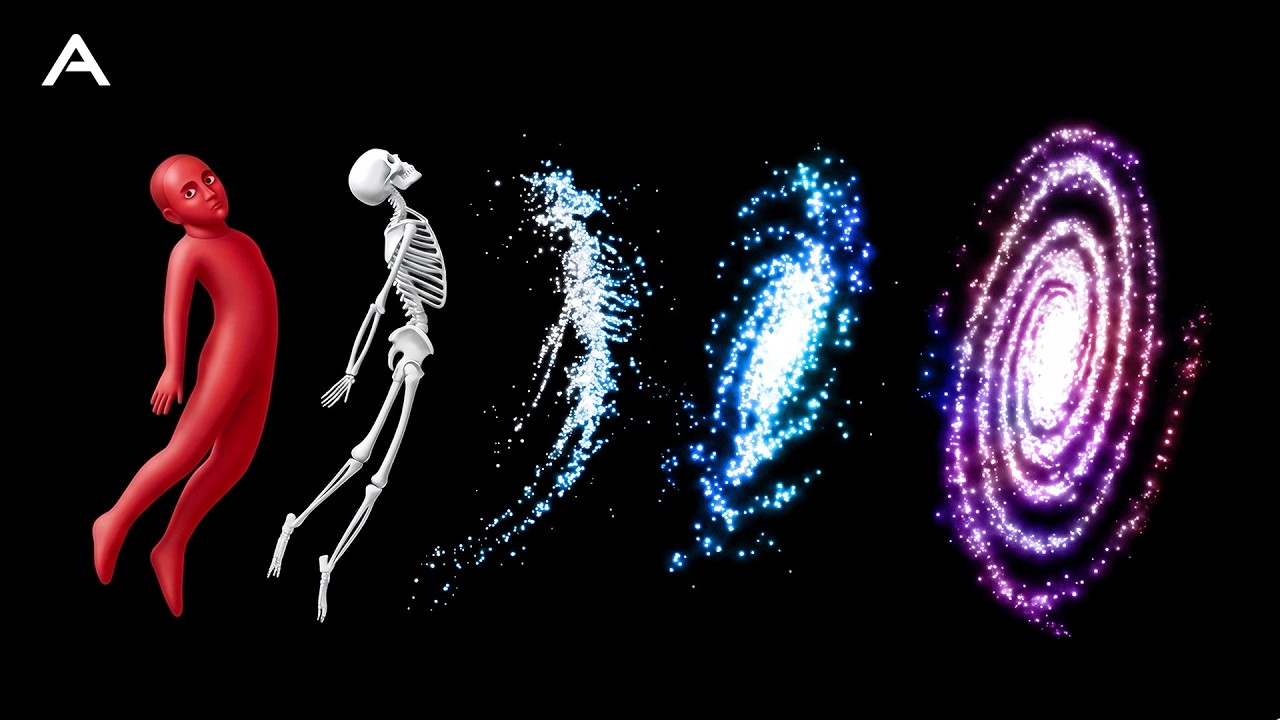
The payoff is cosmological. The film ends by arguing that the lumps in the cosmic microwave background photographed by WMAP are the scars the quantum vacuum left on the early universe, that a galaxy of a hundred billion stars started life as one fluctuation of nothing, and that everything solid you have ever touched is the one part in a billion of matter that survived a near perfect annihilation. Nothing, in this telling, is not the absence of the story. It is the story.
What is inside the box
The film opens on the hardest possible framing of the question, and it does not pretend the question is easy.
"What is nothing? It is an extremely, extremely difficult question to answer, because if you think about it, wherever you look around you, there always seems to be something there." Things, the presenter says, appear almost impossible to escape from. Even trying to imagine true nothingness seems like an impossible task.
Then he makes it a physical question rather than a philosophical one. He holds up a box. What would happen if he removed everything he possibly could from inside it, all the air, the dust, every last single atom, until there was no thing left? What then exists inside the space in the box? Is it really nothing?
That box is the film's recurring prop. It comes back three more times, and each time it comes back the answer to what is inside it has changed.
The stakes are set immediately, and they are not modest. Emptiness is what makes up almost the entire universe. Even the atoms that make up our bodies and the physical world around us comprise mostly of empty space. This is a film about reality at the very furthest reaches of human perception, a place where the deepest mysteries of the universe may be held, and about how humans used ingenious technology to transcend their physical senses and probe the universe at the smallest scales.
And the last line of the opening is the one the whole hour is built to earn: to the best of our knowledge, the entire universe appeared nearly fourteen billion years ago out of nothing.
Aristotle's veto, and why it held for a thousand years
For over a thousand years, the film says, our understanding of empty space was defined by one man: the Greek philosopher Aristotle.
To Aristotle, the concept of nothingness was deeply disturbing. It seemed to present all sorts of problems and paradoxes. He came to believe that nature would forever fight against the creation of true nothingness. As he put it, nature abhors a vacuum.
The film is careful about why that phrase stuck. It was not simply authority. It was that the phrase kept being confirmed. After Aristotle, people who attempted to make empty space faced an uphill struggle, and it seemed nature really was doing everything in its power to stop them. Horror vacui was not a dogma imposed on the evidence. For fifteen hundred years it was the evidence.
The whole mystery, inside a drinking straw
Here the film does the thing that makes it good. Instead of citing medieval pumps and mine shafts, the presenter picks up a drinking straw and demonstrates the entire fifteen hundred year problem at a café table.
"Well, the whole mystery of nothingness is contained inside this simple drinking straw. Let me demonstrate."
Three demonstrations, escalating:
- Suck air out of the top of the straw. More air immediately rushes in to fill the space left behind. Nothing lasts an instant.
- Block off the bottom of the straw and suck. Now the air cannot rush in, so the walls of the straw collapse in on themselves. It is as though the universe will not allow him to make nothingness, and would rather crush the apparatus than permit it.
- Take a sip, then pinch off the top. The liquid stays in the straw. Nature is so intent on stopping him that even the law of gravity is apparently suspended.
His conclusion is generous to the ancients rather than smug about them: "So it is not hard to understand why people believed that it was impossible to make truly empty space."
Then the hinge. There is a very simple explanation for why a straw behaves like this, and it is a reason that would come as a profound shock to the people who worked it out. The straw does not prove that nature hates emptiness. It proves that something is pushing.
Torricelli, 1644: capturing nothing long enough to look at it
By the seventeenth century, strange exceptions were being found to nature's abhorrence of empty space, and it was beginning to seem like there may be ways of tricking nothingness into existence.
The man who would finally do what Aristotle thought impossible was an Italian the film introduces as a Jesuit, Evangelista Torricelli. His experiment would, for the first time, create and capture empty space for long enough to begin to study it.
The film walks the procedure with the apparatus in shot, and a historian narrates the steps:
"This is how the experiment went. With a tube filled with mercury and a finger really strongly clamped over the end. The tube was then turned upside down and then placed into the bath of mercury. And at this point the mercury was released, and you can now see it dropping down. And then it stops."
The presenter asks the question a skeptic would ask, and it is exactly the right one: is the space at the top just trapped air? No. They started with a tube completely filled with mercury and all they did was let it drain out. There was never any air to trap.
But it does not drain out completely. It reaches a level and stops. That refusal to drain is the whole result.
We live at the bottom of an ocean of air
Torricelli's experiment had not only created an airless space. It had also shown that the atmosphere has a specific weight, and the film immediately loops that back to the straw.
The straw crumples when you suck the air out because of the pressure of the atmosphere that surrounds it. Torricelli's apparatus overcame that same pressure by using the extreme weight of mercury and a rigid glass tube. The level of mercury in his tube was a measure of the weight of the atmosphere.
The historian puts the mechanism plainly: "And the level is of course determined by the weight of the mercury on the one hand and the weight of the air pressing down on the other. And so the two balance out like scales. They had found a way to weigh the atmosphere."
Then comes the line the film clearly loves, quoted in the original Italian: "Noi viviamo sommersi nel fondo d'un pelago d'aria elementare." We live at the bottom of an ocean of air.
Suddenly the air really was a substance. Not the default nothing that space is made of, but a heavy fluid we happen to live at the bottom of, exerting a pressure we had never noticed because it is on every side of us at once.
And that immediately sharpens the presenter's original question. If the air is a substance, then what is in the sealed top of the tube, where no substance was ever admitted? Could that really be nothingness?
How can a trick overturn centuries of philosophy
The film pauses here for the intellectual scandal, which it treats as the genuinely interesting part rather than as a footnote.
"Medieval philosophy, much influenced by Aristotle, supposed, reasonably enough, that there is no such thing as empty space in nature. And yet, here is a pretty simple device, a long, thin glass tube with some liquid in it, which is able to produce, says Torricelli, an empty space, thus showing that Aristotle and his disciples are wrong. How can you show that centuries of philosophical tradition are wrong just by doing a trick? That did not seem right at all."
That objection is not stupidity. It is a real question about what an experiment is entitled to prove, asked at the exact moment in history when the answer was changing. The film lets it stand for a beat before delivering the verdict: but Torricelli was right.
Pascal takes the tube up a tower
It fell to the philosopher and scientist Blaise Pascal to develop and refine the work, and as he began investigating Torricelli's ideas he discovered even more peculiar properties.
In Paris, he carried a mercury tube to the top of a huge tower and recorded the mercury dropping to a lower level than it had been on the ground.
That single measurement is one of the most economical experiments in the history of science. If the mercury column is held up by the weight of the air above it, then climbing puts less air above you, and the column must fall. It did. The pressure of the air fell as you went higher.
Pascal's experiments would lead to the realization that the Earth is cocooned in an atmosphere that rapidly thins out the higher you go, eventually becoming the cold, silent expanse of space.
Nothing is everywhere
Torricelli and Pascal had begun to unravel a profound truth, and the film states it as a two word paragraph: nothing is everywhere.
Our Earth is merely a tiny speck of dust floating through a vast expanse of an utterly silent, inhospitable void. The reversal is complete and worth savouring, because it is total. Nature does not abhor a vacuum. A vacuum is nature's default state. The exception is us. The strange, rare, local condition that needs explaining is not the empty tube. It is the ocean of air at the bottom of which we happen to live.
So what was this vast, empty space? Now that it was possible to make it on Earth, scientists became deeply curious, and turned to the properties of the thing itself.
The bell you cannot hear but can still see
After Torricelli and Pascal's experiments, many scientists became fascinated with studying the properties of the vacuum, and they found some very odd things.
Place a ringing bell inside a vacuum and it becomes silent. You cannot hear it from the outside, because having removed all the air there is no medium to carry the sound waves. That result is clean, and it is exactly what the new picture predicts. Sound is a disturbance of a substance. Take away the substance, take away the sound.
Most intriguingly, although you could not hear the bell, you could still see it.
The film lets that sit, because it is the pivot of the entire middle act. Light was crossing the space that sound could not. Light must be travelling through the vacuum. But how could it do this?
For those scientists carrying out experiments with the vacuum there was just one simple conclusion, and given what they had just learned about sound it was not a foolish one. The vacuum was not empty after all. The fact that they could see inside it meant that there still had to be something left in there. Just as air carries sound waves, they believed there had to be a medium carrying the light waves. And whatever it was, it was proving very difficult to get rid of.
The luminiferous ether: nothingness fills back in
The nothingness that had been glimpsed by Torricelli and Pascal now appeared to be a something. A mysterious substance which carried waves of light. And if this substance existed in vacuums on Earth, it meant that it also existed out there.
It appeared once again that nothingness could not exist in nature. Everything in the universe appeared to be sitting within an invisible medium, which scientists called the luminiferous ether.
The historian lays out the logic in a way that makes the ether sound not like a superstition but like the obvious inference it was:
"It was clear for many reasons, many good reasons, that light was a kind of wave. But if light is a kind of wave, what is it a wave in? And sound waves are waves in air. Light waves are waves in what came to be called, from the early 1800s, the luminiferous ether, the light carrying fluid that fills all space. If there is a fluid that fills all space, if light is a wave, nowhere is empty, because light travels everywhere."
And then the sting, which is the film's best single sentence about how science actually moves: "So at the very moment when it seemed absolutely plausible that yeah, sure, there can be empty space, it is obvious that there is not."
That is the second reversal. Torricelli emptied the tube. The wave theory of light immediately refilled it, and refilled the entire cosmos while it was at it, because a wave everywhere requires a medium everywhere.
The problem was that this ether appeared to be so subtle and so intangible that it eluded all attempts to measure it. It would not be until the end of the nineteenth century that an experiment would be built sensitive enough to reveal the truth.
Michelson, and the idea of an ether wind
The experiment would take place in the United States, and Albert Michelson, the scientist who conducted it, would go on to become America's first Nobel Prize winner.
From a young age Michelson had relished tackling the particularly difficult practical problems in physics, and he had earned his reputation by making extremely precise measurements of the speed of light. Having completed that work he travelled to Europe to spend time among some of the best scientists in the world, and it was there that he became fascinated with the topic everyone was talking about: the mysterious luminiferous ether.
One idea in particular captured his imagination. It had been proposed that if you could measure the speed of light accurately enough, it might just be possible to actually deduce the properties of the ether itself.
The reasoning goes like this. If there is an ether, then as the Earth orbits the Sun we should be able to detect its presence. The film's analogy is a hand out of a car window: you feel the rush of wind as the car travels through the air. The Earth, ploughing through a stationary ether at orbital speed, should feel an ethereal wind.
Michelson realized that if this picture of the ether was true, then two light beams should travel at different speeds on Earth, depending on the direction they were moving through that wind.
The difficulty was actually making such a measurement, and here the film is refreshingly concrete about the scale of the problem. The speed of light is over 186,000 miles per second. "Now, that is pretty nifty," the presenter says. "In comparison, the Earth virtually crawls around its orbit." So the difference in speeds between the two light beams would be tiny. Something like one part in a hundred million.
The precision needed to get any sort of meaningful result was way beyond anything scientists thought was possible at the time. But not so the headstrong Michelson. He began to work his way round the problem, developing techniques and precision instruments that he believed would be capable of unlocking the secrets of the ether.
From 1881 Michelson was taking measurements and tweaking and refining his apparatus. But it would not be until 1887, at the Case School of Applied Science in Cleveland, Ohio, that he would finally build a machine sensitive enough to give definitive answers. There he joined forces with another scientist, Edward Morley, to conduct what was to become one of the most notorious experiments in physics.
The 1887 apparatus, and what it was supposed to show
The engineering gets its due. The original apparatus was set in a solid block of sandstone and then suspended in a bath of mercury to remove any vibrations that might affect the measurements. It was incredibly high tech and very expensive. The film's comparison: think of it as an 1880s version of the Large Hadron Collider.
Then the walkthrough of the interferometer itself:
Light is emitted from a source. In the middle is something called a beam splitter, which divides the light up into two paths. Two mirrors reflect the light back to the middle, where the beams recombine at the beam splitter, and the recombined light is sent down to a detector. Because of the wave like properties of light you see a very specific pattern there. If the light has travelled at the same speed along the two paths, you see a bright spot in the middle of the pattern.
Here is the really clever part. Michelson and Morley reasoned that if the Earth really was moving through a stationary ether, the experiment should behave in a very different way. The light that travels against the ether and back again covers its journey in a different time to the light travelling across the ether. So when the light waves recombine they now interfere with each other, and that interference means the image will have a dark spot at its centre.
See that dark spot, and you know the void must be filled with a stationary medium through which the Earth is moving. A shift in the fringes was the ether made visible.
The result nobody wanted, including the men who got it
The presenter is careful here, and it is the most human passage in the film. He cannot be sure exactly what was going through the minds of Michelson and Morley as they began their experiments. But it is a safe bet that, given the scientific consensus at the time, they were convinced the ether really existed. They would have been sure they were going to find light travelling at different speeds as it moved in different directions.
"But it did not."
No matter how they rotated their apparatus, they always found light travelled at the same speed.
And then the detail that makes this a story about people rather than a story about data. Michelson and Morley had obtained an extraordinary and accurate result. But the idea of the luminiferous ether was so ingrained that they believed simply that their experiments had failed.
They had run one of the most important experiments ever performed, gotten a clean answer, and filed it as a failure, because the answer was not on the list of permitted answers.
So what was going on? Why did the experiment not reveal the result they were expecting? How could light always be travelling at the same speed?
The film's answer is one sentence. The ether does not exist.
No matter what light is doing, or how it is travelling, it does not need to be carried along by this mysterious stuff that pervades the vacuum.
Einstein, 1905: light needs no ocean
So how does light move through empty space?
By the end of the nineteenth century light was known to be, in fact, a combination of fluctuating electric and magnetic fields. But it would take the genius of Einstein in 1905 to reveal that this picture of light does not need an ether. He showed that it has the weird property of being able to propagate through completely empty space.
An electromagnetic wave is not a disturbance in a thing. The fields are the thing. The wave carries its own medium with it, which is precisely the property nobody in 1887 was prepared to grant it.
So the message from the failure of the Michelson-Morley experiment is this. There is no ether. Maybe the vacuum is really empty.
"If only it were that simple."
Making money out of nothing
Almost as soon as Michelson and Morley had revealed, by accident, that you really could have nothing, scientists began to discover some very weird properties of nature. In the hundred years that followed the experiment, physics and our understanding of the vacuum were totally transformed.
But the film makes a point that most histories of the vacuum skip, and it is the most underrated ten minutes of the hour: what drove this huge shift was not simply scientific curiosity. In the late nineteenth century the vacuum and its many applications had become big business. Industry was finding ever more ingenious ways to make money out of nothing.
Understanding and harnessing the vacuum turned out to lead to a wealth of new technologies that we just take for granted today. Everything from the light bulb to the television was only made possible because they could contain within them small volumes of vacuum.
The filament inside a light bulb can glow for long periods because it is contained within a vacuum. Expose it to air and it would simply burn out in seconds.
As cities around the world began to electrify, the demand for light bulbs grew massively, and engineers became ever more skilled at creating cheap, efficient vacuums. That technology gave rise to a huge range of gadgets: the valves in radios and early computers, and the television.
This is the film's economic engine for the scientific revolution that follows, and it is an honest one. Nothing became cheap because nothing became profitable.
The vacuum as an instrument
Because vacuum technology was getting so much cheaper and more efficient, scientists all over the world could use it as a tool for research. In empty space, nature's tiniest constituents could now be studied without interference from the contaminant filled air of the outside world.
This revolutionized physics, and the film gives the roll call:
- Because of the vacuum, X-rays were discovered in 1895.
- The following year, the electron was identified for the first time.
- In 1909, Ernest Rutherford would use vacuums to help reveal the strange structure of the atom.
Note what has happened structurally. The vacuum started as the object of study. Here it becomes the instrument, the clean room in which everything else can be studied. Every one of these discoveries required removing the air first.
And these discoveries were all feeding into a radically new picture of the way nature works at its smallest and most fundamental level. A theory that would come to be known as quantum mechanics. The submicroscopic world it describes behaves very differently to the world we are used to. It is a world where, against all common sense, it seems impossible to ever truly have nothing.
The third reversal is now underway, and it is the one that sticks.
Heisenberg: uncertainty is a property of nature, not of your equipment
The film draws the contrast sharply. This is the classical world: action and reaction, cause and effect. It is sensible, certain, and knowable. But the quantum world soon revealed itself to be very different, and there was one discovery that was particularly troubling. It is known as Heisenberg's uncertainty principle.
One of the physicists interviewed states the crucial point, which is the one almost everybody gets wrong:
"In everyday life, we are used to doubt, to uncertainty. How can we be sure that something is this way or that way? Well, it turns out that nature itself is based on indeterminacy, on uncertainty. The world of quantum physics, the microscopic world, is a world of uncertainty. It is a world where you can never be sure of what is going to happen. Not because your measurements are not good enough, simply because at a very fundamental level, nature itself is based on uncertainty."
Not a limit on the instrument. A limit built into the thing being measured.
The two memory sticks
Then the presenter offers what is probably the best homemade analogy in the film, with an explicit warning label attached, which is a courtesy most popularizers do not extend.
"Okay, I would like to try and get across the essence of Heisenberg's uncertainty principle. I am going to use a non mathematical analogy. Now, we have to be careful here. It is just an analogy, so we should not push it too far."
He holds up two identical memory sticks. Identical is the load bearing word, because the fixed capacity is the whole point of the analogy.
Stick one holds a high resolution photograph. A picture of him playing pool. Very detailed. He can zoom right in on a pool ball and still see its precise position, the edges sharp at high magnification. But what he does not know is how fast the ball is moving or what is going to happen next. A still image is all position and no motion.
Stick two holds a movie of the same scene, and the file is the same size as the photograph. Now the whole scene plays out and you can see all the balls moving. But zoom in on any detail and very quickly the balls become fuzzy and blurred.
The conclusion: "So for the same amount of information, although I have gained knowledge about how the balls are moving, I have lost information about their exact positions. So the more I know about where something is, the less I know about how it is moving."
In the quantum world you cannot at the same time know both these quantities exactly. There is no way around this. Heisenberg showed in his mathematics that it is an inescapable feature of reality at this scale.
Energy and time, and the loan you can take out from nothing
Now the film has to connect uncertainty to emptiness, and it does it through the second, less famous form of the principle. The presenter flags the difficulty out loud rather than hiding it: "Now, this is going to sound quite complicated, but it is very important, so I am going to try and explain."
Heisenberg's uncertainty principle can be expressed in terms of a balance between two other quantities: energy and time. The argument runs in three steps, and the box comes back for it.
- Look at a small volume of empty space inside the box over a normal interval of time. In principle you could know how much energy it contains very precisely. Nothing strange yet.
- Slow time down. Now you are looking at a tiny interval of time that has been stretched out. Because you are looking at a smaller interval of time, you have lost precise information about the exact energy in the box. The trade is the same one as position and motion, in a different pair of quantities.
- Shrink the interval and the volume further. Heisenberg's equation now suggests something truly bizarre. "I will be so uncertain about how much energy there is in that part of the box that there is a chance it could contain enough energy to create particles literally out of nowhere. Provided that somehow they went away again very quickly."
Heisenberg's uncertainty principle seemed to suggest that in truly tiny amounts of time and space, something could come from nothing.
But then what? If particles could pop into existence, where do they go? Why do we not see these particles appearing all around us?
The vacuum is alive
The answer comes from one of the interviewed physicists, and it is delivered as a flat statement of fact rather than as a flourish:
"The vacuum, contrary to what one normally expects from the vacuum, is alive. It is alive with what physicists call quantum fluctuations. In the vacuum, little packets of energy appear and disappear very, very quickly. And this is perfectly allowed by the laws of physics. It is so allowed that it has a name. It is called Heisenberg's uncertainty principle, which tells us that you could borrow energy from nothing so long as you pay it back quickly enough."
The presenter repeats it, because it is the film's thesis in four words: the vacuum is alive. "Bizarre though these ideas seem, they are, I promise you, fundamental to our universe."
Note what is still missing at this point in the argument, and the film is careful about the gap. Heisenberg tells you energy may be borrowed. He does not tell you what mechanism would let the borrowed energy turn into matter and then reliably erase itself. Without that, "you could borrow energy" is an accounting rule with no machinery behind it.
Supplying the machinery is the job of the man the film spends its entire third act on.
Bishop Road Primary School, and a unit of shyness
To see how this can be, the story of nothing takes the film to one of the most gifted and oddest characters in the whole history of physics.
The presenter stands outside Bishop Road Primary School in Bristol. Almost a hundred years ago it was attended by two students who were destined for greatness. One of them, Archibald Leach, would go on to conquer Hollywood, becoming better known as Cary Grant. The other was a quiet, shy, and rather intense boy, two years younger than Grant, who would become one of the greatest scientists Britain has ever produced: the theoretical physicist Paul Dirac.
The biographer interviewed does not soften him:
"Even by the standards of theoretical physicists, Dirac was a very queer bird. He was not someone you would go for a beer with. Intensely focused man of extremely few words, very, very little empathy, and someone of rectilinear thought."
These personality traits were key to Dirac's genius, but they often resulted in difficult or awkward social situations with his peers. Even in casual conversation Dirac would never speak unnecessarily. He would often leave long pauses between sentences while he worked out the most precise and concise way of expressing himself.
Which produced the joke that has outlived most of the physics of the period. Friends coined the term a Dirac: the smallest number of words it is possible to speak in one hour while still taking part in a conversation. A unit of shyness.
Dirac's unusual personality had its roots in a difficult and troubled childhood, but from a young age he had found solace in the classroom. In particular he excelled at both mathematics and technical drawing.
The visualizer
The film's real argument about Dirac is not that he was odd. It is that a specific and unusual cognitive style, trained in a specific classroom, produced a specific equation. The biographer:
"This was something that cultivated his visual imagination. In math classes he was looking at mathematical symbols, he was looking at similar things but in a geometric way in his technical drawing class. Now, it is very, very, very suggestive of the way he looked at physics later on, because Dirac always stressed that he was preeminently a visualizer. He was someone who had a geometric look at physics. He was not interested per se in mathematical symbols, rather he wanted to have a visual sense of what was going on in the mathematics."
Dirac continued that visual training by taking a degree in engineering before going to Cambridge to study mathematics. It would be there that he began to unravel the deepest mysteries of the vacuum and uncover what was really going on in empty space. But his insight sprang from a seemingly unrelated difficulty.
1928: two theories that would not marry
By 1928, physics was struggling with a big problem. The two most important theories that describe how the universe worked did not agree with each other.
On the one hand there was Einstein's special theory of relativity, encapsulated in the famous equation E = mc². A beautiful, simple, and elegant theory that describes the behaviour of things close to the speed of light.
On the other hand there was Planck's discovery of the quantum and the revolution that followed, describing the bizarre rules of the very, very small.
The problems arose when trying to describe situations where things were small enough for quantum effects to be felt but travelling fast enough for special relativity to be important. Specifically, there were huge problems trying to describe the electron, a tiny particle whizzing around inside an atom. It is both, at once, and neither theory could handle it alone.
The film states the stakes properly. If both these theories were true, then they should be able to be used together to give a mathematical description of the electron. But what if this could not be done? What if quantum physics and special relativity could not be married? That would mean one or other of these two cornerstones of physics had to be wrong.
A way had to be found for the two theories to be married together, and it would be Dirac who achieved it. His unification of the special theory and the rules of the quantum world would rank as one of the greatest mathematical accomplishments of the twentieth century. And it would lead, inadvertently, to a radical new picture of nothing.
2001: A Space Odyssey
To get a non mathematical sense of what Dirac did and how he did it, the presenter goes to the cinema to see one of Dirac's favourite films, 2001: A Space Odyssey. Understanding why it appealed to him gives an insight into how he managed to solve the problem.
"If you look at 2001, it was, as Kubrick said, a demonstration that you could make a really good movie script without words, but with the power of visual imagery. Now, that in some ways is very closely analogous to Dirac's theoretical physics, because for him what was central were the mathematical equations. And moreover, he had a visual sense of what those equations meant."
The abstract images of 2001 appealed to Dirac because they captivated his visual imagination. And it was that highly developed and unusual way of thinking, honed in his school days, that enabled him to visualize a unique way of describing the electron. A description that finally managed to unite Einstein's special theory of relativity and the weird world of quantum mechanics.
The equation, and the iceberg beneath it
Today it is known simply as the Dirac equation. It may look like a small collection of symbols, but to a mathematician this equation is profoundly beautiful: a complex and symmetrical synthesis of mathematical ideas expressed with stunning clarity.
The presenter visits the commemorative plaque at Bishop Road, Dirac's primary school, with the equation carved on it. Within these few symbols lie profound truths about the universe.
"But do not be deceived by its apparent simplicity. Think of this equation as the tip of a giant mathematical iceberg. Each of these terms relates to entire branches of mathematics and the particular relationships between them. Beneath this equation are mathematical ideas that have been developed and honed by many, many other great individuals."
Then the film's best piece of writing about what an equation actually is, from one of the interviewees:
"If you think of a poem, you can think of it as the most supercharged kind of language, the way you compress meaning into a very, very brief area on the page, right? Dirac was producing equations that had that kind of concision, and you can then unpack them just as you reread a Shakespeare sonnet and see more and more in it, more and more elegance. Same with the Dirac equation. You find an equation there, and you can keep finding things that were not obvious on first reading."
And the line that sets up everything that follows: Dirac once said that the equation was smarter than he was, because it actually gave more stuff out than he put into it.
The two equations nobody ordered
There was one particularly odd thing the equation seemed to be saying to Dirac. Something that would redefine the concept of empty space forever.
In his description of the electron, Dirac had been forced to use a collection of four equations, represented by the symbol gamma, in order to make special relativity and quantum mechanics fit together. But the need for four equations seemed strange.
To Dirac and other physicists in the 1920s, the first two were quite recognizable. They described the behaviour of an electron as it had been observed in the laboratory.
But the second two were very strange. They seemed to be saying that there was some other type of electron that could exist. One that had never been seen before.
This is the moment the film has been building towards since the drinking straw, and it is worth being precise about its shape. Nobody went looking for a new particle. Nobody had an anomalous measurement demanding one. The mathematics that was written down to solve a completely different problem, the marriage of two theories, came back with extra solutions attached, and the extra solutions turned out to be about the structure of empty space.
The anti-electron
The presenter sets the scene with a scaled up model. This is the normal world we are all familiar with, and here, scaled up many, many times, is a regular electron of the type contained within the trillions of atoms that make up the table, and him, and everything else in the universe.
Dirac realized that the mysterious new elements in his equation predicted the existence of a strange new kind of particle. In some ways just like the electron, and yet at the same time very, very different.
He gradually became convinced that the new parts of his equation were describing something that could be thought of as an anti-electron. In many ways it was the mirror image of an electron, having opposite properties like electric charge.
And in principle, an anti-electron could form part of an anti-atom. Many anti-atoms could fit together to make an antimatter table, or even an anti-me.
But the weirdness did not end there. Dirac realized that if things and anti-things ever met each other, they would instantly annihilate, turning all their mass into energy, disappearing completely.
Here, finally, was the answer
The two halves of the film's argument now snap together, and the film says so explicitly.
Heisenberg's uncertainty principle had suggested that matter could pop into existence for incredibly short periods of time. Now Dirac had provided the mechanism by which matter could be created out of the vacuum, and just as quickly disappear again.
So the presenter takes another look at the box. Whenever a particle pops out of empty space, so simultaneously does its antiparticle. "Although this sounds completely ridiculous, let me assure you that it is true."
So whenever you try to remove everything you can from empty space, it is still always awash with these fluctuations. Within nothingness there is a kind of fizzing, a dynamic dance as pairs of particles and antiparticles borrow energy from the vacuum for brief moments before annihilating and paying it back again.
One of the physicists retraces the whole arc of the film in a single answer, which is the cleanest summary of the argument anyone gives:
"Dirac's theory of the electron and the idea of antimatter gives us a completely new picture of the vacuum. Before, you could think about vacuum as just empty space, so to speak. Relativity had said you do not need an ether, so the picture was of the vacuum being empty. But when you bring relativity and quantum theory together, then you have for certain this notion of electron and antielectron pairs just appearing out of the vacuum. Right? So you can think of these pairs just sprouting all over the place in the vacuum. So the vacuum goes from being nothing to being a place absolutely teeming with matter antimatter creation."
Dirac's ideas about empty space were refined and developed into what is known today as quantum field theory, and these strange fleeting things within nothing became known as virtual particles.
So it seems nothingness is in fact a seething mass of virtual particles appearing and disappearing trillions of times in the blink of an eye.
Willis Lamb, and how you photograph a shove from nothing
Everything so far is theory, and the film knows it. So it goes to a laboratory to see whether any of it can be caught in the act.
The presenter goes to Imperial College London to see the effects of these virtual particles for himself. Thanks to a brilliant experiment by an American scientist called Willis Lamb, we now have a way to conclusively show that there is activity within apparent nothingness. But in order to glimpse it, you have to peer deep within a single atom.
So what did Lamb do? His experiment relies on the quantum rules of the atom. Within atoms, electrons have very specific discrete energies in the way they orbit around the nucleus. Lamb's experiment showed that if the vacuum really was full of hidden fluctuations, then these would cause the electron's orbit to wobble ever so slightly.
The analogy: think of the electron as a plane flying along and hitting some turbulence, forcing it up to a slightly higher altitude. If the vacuum is genuinely empty there is no turbulence, and the electron sits exactly where the clean theory says it should. If the vacuum is fizzing, the electron gets nudged, and its energy level shifts by a tiny, calculable amount. That shift is the Lamb shift, and it is the vacuum's fingerprint on a real object.
The modern version runs like this. Contained within a vacuum chamber are a small number of atoms. Lamb used microwaves in his original experiments; in this version the team at Imperial are using lasers to probe the electrons.
If it all looks very complex, the presenter says, just remember how small a measurement it is they are trying to make. The apparatus has to be sensitive enough to pick up minute changes in the behaviour of something that is itself extremely tiny.
Then the scaling image, which is the most vivid number in the film. Imagine you could scale up the wobble in the electron being measured to the size of an apple. That would mean the vacuum chamber behind him would scale up to being a trillion miles in size, something like a hundred times the size of the entire solar system. It would take light about forty days just to travel from the top of the chamber down to the bottom.
That is the ratio between the thing being measured and the machine measuring it.
The peak that should not be there
The presenter fires up the laser. The monitor shows what is going on inside the vacuum chamber at the minutest scales.
"Now look at this peak that has appeared. It may not look very exciting, but it is telling us something really remarkable, because this is measuring the amount that the electron is being wobbled about by the vacuum itself. If the vacuum were truly empty, this peak would not exist. We would just get a flat line."
That is the experimental payoff of the whole hour. A flat line would mean Torricelli won outright and space is simply nothing. Instead there is a peak, and the peak is the shove.
What it is telling us is that however hard we try to remove everything we can from space, we can never get it truly empty. Everywhere in the universe, space is filled with this vacuum that has a deep, mysterious energy.
And it does not end there. Using the mathematics laid out by Heisenberg, Dirac, and others, you can calculate the amount by which the electron should be affected. When you run the real physical experiment, the answer you get matches the theory to one part in a million.
The film's verdict: the theory of quantum mechanics is the most accurate and powerful description of the natural world that we have. The agreement is not a rough vindication of a nice story. It is one of the sharpest numerical agreements in science, and what it is confirming is the structure of nothing.
Written into the stars
There is a much more dramatic way to see the effects of these quantum fluctuations, and it is that they are written into the stars.
Our best theories tell us that as the universe sprang from the vacuum it expanded very rapidly, and this means the rules of the quantum world should have contributed to the large scale structure of the entire cosmos.
The argument turns on scale, and it is elegant. When our universe first came into existence it was many times smaller than a single atom. Down at that size it is governed not by the classical rules we are familiar with, but by the weird rules of the quantum world. Then it expanded, and whatever quantum texture it had at that moment got stretched out with it.
The presenter does not hide how much he likes this: "This is for me one of the most profound and beautiful ideas in the whole of science, that it is quantum reality that has shaped the structure of the universe we see today. Our universe is just the quantum world inflated many, many times."
Nothing really has shaped everything.
The baby photo of everything
And we now have a way to see this. The film shows a picture of the first light released after the Big Bang, taken by the WMAP space mission team. Think of it as a baby photo of everything.
One of the cosmologists gives the analogy its proper weight:
"This is like taking a picture of an embryo that is twelve hours after conception, compared to taking a picture of a person who is fifty years old, right? At twelve hours you may have two cells. This is very, very early in the universe's life, and yet we are seeing what is equivalent to the DNA, the blueprint for how the universe is going to develop."
With the help of highly sensitive satellites, the WMAP team were able to study this image of the embryonic universe in amazing detail. And when they did, tiny variations in its temperature were revealed.
It soon became apparent that those tiny differences in temperature are in fact the scars left by the quantum vacuum on our universe. These irregularities, created in the first moments of existence by the teeming quantum vacuum, meant that the matter of the universe did not spread out completely evenly. Rather it formed vast clumps that would evolve into the galaxies and clusters of galaxies that make up the universe today.
If the early universe had been perfectly smooth, nothing would ever have collapsed into anything. Structure requires lumps, and the lumps came from the fizz.
A galaxy that began as a fluctuation
The cosmologist interviewed makes the case for why this was a revolution rather than a refinement:
"The application of quantum physics to cosmology, to the universe as a whole, was revolutionary. It really changed our entire perception of the evolution of the universe. Because it turns out that quantum physics provides a natural mechanism, through quantum fluctuations, to seed the early universe with small irregularities that would later grow to make galaxies. The thought is really overwhelming. The idea that an object with billions of stars like the Milky Way began life as a quantum fluctuation, as what we call a fluctuation of the vacuum, an object of submicroscopic scales, it really is mind boggling."
It now appears as if the quantum world, the place we once thought of as empty nothingness, has actually shaped everything we see around us.
And the film closes the loop on a question most people never think to ask, which is why there are so many galaxies:
"What happens is something that was a small fluctuation, a tiny quantum mechanical fluctuation, becomes our galaxy. Right? Or becomes a cluster of galaxies, whatever, because there are very many quantum fluctuations. So it answers one of the questions we have. Why are there a hundred billion galaxies in our viewpoint? Well, in a drop of water there are many more than a hundred billion quantum fluctuations, right? In an atom there are that many. The vacuum has all this bubbling going on all the time."
The count of galaxies is not a large number. Measured against the fluctuation rate of the vacuum it is a small one. The teeming, seething activity of nothing, and the quantum fluctuations within it, were the seeds which grew into the universe we see today.
One in a billion
That idea gives rise to one final revelation, and it is the one that puts the reader inside the story rather than watching it.
Our best theories about the cosmos tell us that at the beginning of time the universe sprang from the vacuum, creating not only vast amounts of matter, but also the strange stuff predicted by Paul Dirac: antimatter.
But the universe we see today is made of matter. Nearly all of the antimatter seems to have vanished. Where did it go?
"According to current theory, the Big Bang produced equal amounts of matter and antimatter, but as the universe cooled down, matter and antimatter annihilated almost perfectly, but not quite. For every billion particles of matter and antimatter, one was left behind. The matter and antimatter that annihilated to produce radiation gave rise to the heat of the Big Bang that we see today in the form of the microwave background radiation. The little particle that was left behind for every billion that annihilated is what makes galaxies, stars, planets, and people."
Read that carefully, because it makes two things out of one event. The heat of the cosmic microwave background is the receipt for the annihilation. Everything solid is the rounding error.
The presenter says it without cushioning: "So we are simply the debris of a huge annihilation of matter and antimatter at the beginning of time. The leftovers of an unimaginable explosion."
Four hundred years from a tube of mercury
All these insights have arisen from simply trying to understand what nothing really is. What we once thought of as the void now seems to hold within it the deepest mysteries of the entire universe.
In the four hundred years or so since Torricelli and Pascal began exploring vacuums here on Earth, we have begun to understand in ever greater detail the world at the very limits of our perception. And in doing so, we have uncovered the strange truth about reality itself.
The closing line, and the film earns it: there is a profound connection between the nothingness from which we originated and the infinite in which we are engulfed.
| Era | What "the vacuum" was | What settled it | Is space empty? |
|---|---|---|---|
| Aristotle to 1643 | Impossible. Nature would rather bend its own laws than allow it | Every pump, straw and siphon appearing to confirm it | No, and it cannot be |
| Torricelli, 1644 | A real, makeable void at the top of a mercury column | The column stops instead of draining, balancing the weight of the air | Yes, and we just made some |
| Pascal, after 1647 | Nature's default state, with our air a thin local exception | Mercury falls when you carry the tube up a tower | Yes, nearly everywhere |
| 1800s, the ether | A light carrying fluid filling all space, undetectable but necessary | Light crosses a vacuum a bell cannot ring across, and waves need a medium | No, it is full of ether |
| Michelson-Morley, 1887 | Nothing at all. No wind, no medium, no drag | The interferometer sees no fringe shift at any rotation; Einstein explains why in 1905 | Yes, genuinely |
| Heisenberg and Dirac | A fizzing sea of particle and antiparticle pairs borrowing energy and paying it back | Energy time uncertainty plus antimatter; confirmed by the Lamb shift to one part in a million | No, and it never can be |
- 4th c. BC Aristotle rules that nature abhors a vacuum. The verdict holds for over a thousand years, and keeps being confirmed by every pump and siphon anyone builds.
- 1644 Evangelista Torricelli inverts a mercury filled tube into a mercury bath. The column falls, then stops. He has made a genuine void and, in the same object, the first barometer. "We live at the bottom of an ocean of air."
- 1640s Blaise Pascal carries a mercury tube to the top of a tower in Paris and finds the level lower than on the ground. The atmosphere has a top, and beyond it is the cold, silent expanse of space.
- later 1600s The bell in a jar: pump out the air and the ringing stops, but you can still see the bell. Sound needs a medium; light apparently does not care. The question that creates the ether.
- early 1800s The luminiferous ether is named: a light carrying fluid filling all space, required because a wave must be a wave in something. Nowhere is empty again.
- 1881 Albert Michelson, already famous for precision measurements of the speed of light, begins hunting the ether wind. The effect he needs to see is about one part in a hundred million.
- 1887 With Edward Morley at the Case School of Applied Science in Cleveland, on sandstone floated in mercury, the interferometer returns a null result at every rotation. They conclude their experiment failed.
- 1895 X-rays are discovered, made possible by cheap industrial vacuum. The vacuum has become an instrument rather than an object of study.
- 1896 The electron is identified for the first time, again inside a vacuum.
- 1905 Einstein shows that light, as fluctuating electric and magnetic fields, propagates through completely empty space. The ether is not just undetected, it is unnecessary.
- 1907 Michelson becomes America's first Nobel Prize winner, for the precision optical work that produced the result he thought was a failure.
- 1909 Ernest Rutherford uses vacuums to reveal the strange structure of the atom: almost entirely empty space.
- 1920s Heisenberg's uncertainty principle. Indeterminacy is a property of nature, not of the instrument. In its energy and time form it permits borrowing energy from nothing, provided it is repaid fast enough.
- 1928 Paul Dirac marries special relativity to quantum mechanics in one equation, and is forced into four gamma terms. Two describe the known electron. Two describe something never seen.
- c. 1931 Dirac becomes convinced the extra solutions describe an anti-electron, mirror image of the electron, which annihilates on contact with it. This is the missing mechanism for creating matter from the vacuum and erasing it again.
- 1947 Willis Lamb measures a tiny wobble in an atom's electron energy levels, caused by the vacuum shoving it. Theory and experiment agree to one part in a million. The fizz is real and measured.
- post war Dirac's picture is refined into quantum field theory, and the fleeting pairs get their name: virtual particles.
- 2000s The WMAP mission photographs the first light after the Big Bang and maps its temperature variations. The lumps are read as scars left by the quantum vacuum, the seeds that grew into galaxies and clusters.
- today The standing account: equal matter and antimatter annihilated almost perfectly, leaving one particle in every billion. That residue is every galaxy, star, planet and person, and the annihilation itself is the heat of the microwave background.
Key takeaways
- Aristotle's veto was not stupidity, it was evidence. For fifteen hundred years every straw, pump and siphon behaved exactly as though nature would rather break its own rules than permit a void. The straw demonstration makes that case honestly before demolishing it.
- Torricelli's tube is two discoveries in one object. The gap at the top is the first deliberate vacuum. The height of the column below it is the first measurement of the weight of the atmosphere. You cannot have either result without the other.
- The reversal was total, not partial. After Pascal, the vacuum stops being the impossible exception and becomes nature's default state. Our ocean of air is the local anomaly.
- The ether was a good inference from a good premise. Light was a wave, waves are waves in something, therefore something fills all space. The film treats it as reasonable rather than foolish, which is why its collapse lands.
- Michelson and Morley filed the most important null result in physics as a failure. The instrument was sensitive to one part in a hundred million, the answer was zero at every rotation, and consensus was strong enough that they doubted the machine rather than the ether.
- Einstein removed the need rather than the substance. Light as fluctuating electric and magnetic fields carries its own medium, so no ocean is required for it to swim in.
- Cheap vacuum was an industrial product before it was a research tool. Light bulbs and radio valves made vacuum technology cheap, and cheap vacuum is what enabled X-rays in 1895, the electron, and Rutherford's atom in 1909.
- Uncertainty is about nature, not about instruments. The memory stick analogy makes the trade concrete: for a fixed budget of information, sharpening position blurs motion.
- The energy and time form of uncertainty is where emptiness breaks. Look at a small enough volume over a short enough interval and the energy becomes uncertain enough to make particles, provided they vanish fast enough.
- Dirac supplied the missing machinery, by accident. The equation needed four gamma terms; two described a particle nobody had seen. Antimatter gives borrowed energy a way to erase itself, because a pair created together can annihilate together.
- The Lamb shift is the receipt. The vacuum nudges an electron in a real atom, and theory matches experiment to one part in a million. Without the fizz, the monitor would show a flat line.
- Nothing shaped everything. Quantum fluctuations in a universe smaller than an atom were stretched by expansion into the temperature lumps WMAP photographed, and those lumps became galaxies and clusters.
- We are the rounding error. Matter and antimatter annihilated almost perfectly. One particle in a billion survived, and that residue is every star and every person. The annihilation itself is the microwave background.
Where it stands
The physics in this film is mainstream and the experiments are real. A few places where the film compresses, and a few things worth knowing that it leaves out:
- Torricelli was not a Jesuit. He was educated at a Jesuit college and was a devout Catholic, but he was a lay mathematician, a student and then secretary of Galileo, not a member of the order. The film's description is a slip.
- The date is usually given as 1643 or 1644. The experiment was performed under Torricelli's direction in 1643 and described in his letters of 1644, which is why sources differ.
- The electron was identified in 1897, not 1896. The film says X-rays in 1895 and the electron "the following year". J. J. Thomson's cathode ray work is conventionally dated to 1897.
- Michelson's Nobel is best described as the first won by an American in the sciences. He won the physics prize in 1907; Theodore Roosevelt had taken the Peace Prize in 1906.
- Pascal's decisive altitude experiment is the one the film does not show. The Paris tower result is real, but the famous version is the 1648 ascent of the Puy de Dôme, carried out on Pascal's instructions by his brother in law Florin Périer, where the far greater height gave a far larger drop.
- The positron's discovery is missing. Dirac predicted the anti-electron around 1931; Carl Anderson found it in cosmic ray tracks in 1932, which is the moment the extra solutions stopped being mathematics and became a particle. The film jumps straight from prediction to the modern picture.
- The Casimir effect never appears, which is a surprising omission given it is the other headline demonstration that the vacuum pushes on real objects. The film puts all its experimental weight on the Lamb shift instead.
- So does the vacuum catastrophe. If you calculate the energy density of the quantum vacuum and compare it to the value cosmology actually measures, the two disagree by many tens of orders of magnitude. It is arguably the largest unresolved discrepancy in physics, and it sits directly underneath the film's closing argument that vacuum energy shaped the cosmos.
- "Particles popping in and out of existence" is a picture, not a literal census. Virtual particles are terms in a calculation, and how literally to read them is genuinely contested among physicists. What is not contested is that the calculations they belong to predict measurements like the Lamb shift with extraordinary accuracy.
- The "nothing" the universe came from is a physicist's nothing. It is a state with fields, laws and quantum structure, not the philosopher's absence of anything whatsoever. The film gestures at this distinction without drawing it.
- The upload does not caption its speakers. The presenter and the interviewed historian, biographer and cosmologists are all identifiable on screen but unnamed in the transcript, so quotes here are attributed by role rather than by name.
Chapters
- 0:00 What is nothing, and what is inside the box
- 2:29 Aristotle: nature abhors a vacuum
- 3:22 The whole mystery inside a drinking straw
- 4:59 Torricelli does what Aristotle said was impossible
- 6:06 The tube stops draining: weighing the atmosphere
- 7:20 We live at the bottom of an ocean of air
- 8:00 How can a trick overturn centuries of philosophy
- 8:45 Pascal carries the tube up a tower
- 9:40 Nothing is everywhere: the vacuum as nature's default
- 10:19 The bell you cannot hear but can still see
- 12:10 The luminiferous ether fills space back in
- 13:35 Michelson and the hunt for the ether wind
- 14:51 The hand out of the car window
- 16:34 1881 to 1887: building an impossible instrument
- 17:35 Inside the interferometer: beam splitter, mirrors, fringes
- 18:50 What an ether would do to the pattern
- 20:05 The null result, and two men who called it a failure
- 21:18 Einstein 1905: light needs no medium
- 22:34 Making money out of nothing: bulbs, valves, television
- 24:17 The vacuum becomes an instrument: X-rays, the electron, Rutherford
- 25:42 Classical certainty versus the quantum world
- 26:52 Heisenberg's uncertainty principle: the two memory sticks
- 29:16 Energy and time: borrowing from nothing
- 31:28 The vacuum is alive
- 32:21 Bishop Road Primary School, Cary Grant, and a unit of shyness
- 34:21 The visualizer: mathematics as technical drawing
- 36:00 1928: two theories that would not marry
- 38:07 Dirac at the cinema: 2001: A Space Odyssey
- 39:35 The equation on the plaque, and the iceberg beneath it
- 41:32 Four gammas, and the two equations nobody ordered
- 43:23 The anti-electron, antimatter, and annihilation
- 44:48 The box again: pairs fizzing in and out of nothing
- 46:54 Willis Lamb, and peering inside a single atom
- 48:28 Imperial College: lasers, an apple, and a trillion miles
- 50:05 The peak on the monitor, matched to one part in a million
- 51:21 Written into the stars: the quantum world inflated
- 52:49 WMAP and the baby photo of everything
- 54:43 A galaxy that began as a fluctuation
- 56:50 One in a billion: why any matter survived
- 58:32 Four hundred years from a tube of mercury
Notable quotes
Noi viviamo sommersi nel fondo d'un pelago d'aria elementare. We live at the bottom of an ocean of air. Torricelli, quoted by the interviewed historian of science, 7:20
How can you show that centuries of philosophical tradition are wrong just by doing a trick? That did not seem right at all. the interviewed historian of science, on the reception of Torricelli's result, 8:00
Nature doesn't abhor a vacuum. A vacuum is nature's default state. the presenter, 9:40
So at the very moment when it seemed absolutely plausible that yeah, sure, there can be empty space, it is obvious that there is not. the interviewed historian of science, on the arrival of the ether, 12:10
Think of it as an 1880s version of the Large Hadron Collider. the presenter, on the Michelson-Morley apparatus, 16:34
But the idea of the luminiferous ether was so ingrained that they believed simply that their experiments had failed. the narration, on the 1887 null result, 20:05
Industry was finding ever more ingenious ways to make money out of nothing. the narration, on the late nineteenth century vacuum business, 22:34
Not because your measurements aren't good enough, simply because at a very fundamental level, nature itself is based on uncertainty. one of the interviewed physicists, on Heisenberg, 25:42
The more I know about where something is, the less I know about how it's moving. the presenter, ending the memory stick demonstration, 26:52
The vacuum, contrary to what one normally expects from the vacuum, is alive. It's alive with what physicists call quantum fluctuations. one of the interviewed physicists, 31:28
You could borrow energy from nothing so long as you pay it back quickly enough. one of the interviewed physicists, on the energy and time form of uncertainty, 31:28
Even by the standards of theoretical physicists, Dirac was a very queer bird. He was not someone you'd go for a beer with. the interviewed biographer, 32:21
A Dirac, which stands for the smallest number of words it's possible to speak in one hour while still taking part in a conversation. It's a sort of unit of shyness. the presenter, 32:21
Dirac actually once said that the equation was smarter than he was, because it actually gave more stuff out than he put into it. the interviewed biographer, 39:35
So the vacuum goes from being nothing to being a place absolutely teeming with matter antimatter creation. one of the interviewed physicists, 44:48
If the vacuum were truly empty, this peak wouldn't exist. We'd just get a flat line. the presenter, at the Imperial College experiment, 50:05
Our universe is just the quantum world inflated many, many times. Nothing really has shaped everything. the presenter, 51:21
We're seeing what's equivalent to the DNA, the blueprint for how the universe is going to develop. one of the interviewed cosmologists, on the WMAP image, 52:49
Why are there a hundred billion galaxies in our viewpoint? Well, in a drop of water, there's many more than a hundred billion quantum fluctuations. one of the interviewed cosmologists, 54:43
So we're simply the debris of a huge annihilation of matter and antimatter at the beginning of time. The leftovers of an unimaginable explosion. the presenter, 56:50
There's a profound connection between the nothingness from which we originated and the infinite in which we're engulfed. the closing narration, 58:32
Resources mentioned
People
- Aristotle, whose ruling that nature abhors a vacuum framed the question for over a thousand years
- Evangelista Torricelli, who made the first sustained vacuum and the first barometer in one object in the 1640s
- Blaise Pascal, who carried the tube up a tower and gave the atmosphere an upper edge
- Albert A. Michelson, precision measurer of the speed of light and the film's America's first Nobel Prize winner
- Edward Morley, his collaborator on the 1887 experiment
- Albert Einstein, whose 1905 work showed light needs no medium
- Max Planck, whose quantum began the other half of the 1928 collision
- Ernest Rutherford, who used vacuums to reveal the structure of the atom in 1909
- Werner Heisenberg, whose uncertainty principle makes borrowing energy from nothing legal
- Paul Dirac, whose equation married relativity to quantum mechanics and predicted antimatter
- Willis Lamb, whose shift turned the fizzing vacuum into a measurement
- Cary Grant, born Archibald Leach, Dirac's schoolmate at Bishop Road
- Stanley Kubrick, whose 2001: A Space Odyssey was one of Dirac's favourite films
Experiments, ideas and instruments
- Torricelli's experiment, the mercury tube inverted into a mercury bath
- The luminiferous ether, the light carrying fluid named in the early 1800s
- The Michelson-Morley experiment, 1887, at the Case School of Applied Science in Cleveland, Ohio
- The Michelson interferometer, beam splitter, mirrors and interference fringes
- The Large Hadron Collider, the film's modern comparison for 1880s big science
- The incandescent light bulb and the vacuum tube, the industries that made vacuum cheap
- X-rays, discovered 1895, and the electron
- Quantum mechanics and the uncertainty principle
- Special relativity and E = mc²
- The positron and matter antimatter annihilation
- Quantum field theory and virtual particles
- The Lamb shift, reproduced with lasers at Imperial College London
- The WMAP mission and the cosmic microwave background
- The Milky Way, one of roughly a hundred billion galaxies that began as fluctuations
Places
- Bishop Road Primary School, Bristol, and the plaque carrying the Dirac equation
- Imperial College London, where the film runs a modern Lamb shift measurement
Source