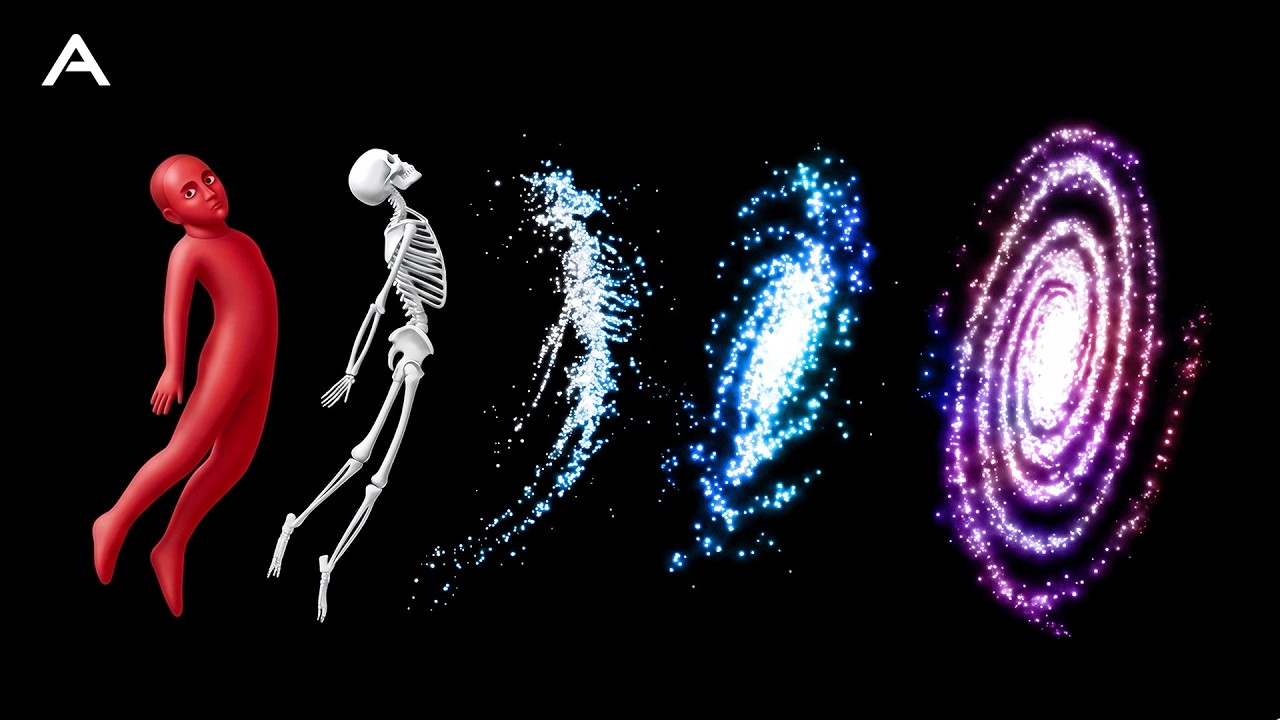
At a glance
Brian Krehbiel sits down for 69 minutes with Angelo DiLullo, MD, an anesthesiologist who completed two residencies (family medicine, then anesthesiology) and who says that at 24 years old the sense of being a self located behind his eyes simply stopped. The format is what makes it: Krehbiel does not interview, he interrogates. He arrives with a list of the biggest questions a person can ask, plus a stack of rapid fire statements lifted from New Age forums and Christian doctrine and psychedelic trip reports, and he puts each one in front of DiLullo to see what survives contact. What is Earth. What happens when we die. Why is there something instead of nothing. Is there a God. Was Jesus talking about this. Do bodies have souls. Is history real.
DiLullo's answers all run through one claim, which he treats as an observation rather than a belief: the self that seems to sit at the center of experience is a thought, a very tenacious one, and when it is seen through, experience does not go dark or empty, it goes boundless. Everything else follows from that. Death is a human demarcation imposed on a field that has no edges. Time is a prison built out of a single believed sentence. History is a thought appearing right now, on the same footing as a thought about breakfast. God as a picture in the mind is a thought, but the question of whether that thought points at something real is the only question worth keeping. Science is not the enemy, it is the wrong instrument, and self inquiry done precisely is, in his phrase, the ultimate empiricism.
He refuses on principle to hand over the conclusion. "I could show you where the fork is and show you where the food is," he says, "but I'm not going to tell you the answer." So the interview becomes a running demonstration of a method rather than a doctrine, and the last third turns to the hard practical edges: that awakening pushes repressed material to the surface and there is no trauma free path through it, that 5-MeO-DMT shows you the territory for ten minutes and changes nothing permanent, and that the whole thing eventually has to be done, as he puts it, dead sober. The closing ten minutes are the most vivid: a kaleidoscope in which every fragment co arises with every other, Indra's net, and a dark hallway where the lights come on only where you are standing and there is nobody in the hallway.
The cold open: what turns you off
The video opens on the answer to a question we never hear asked in full. What turns you off, in general? DiLullo: "Smugness."
Then, immediately, the counter move that sets the tone for the whole hour. "I always ask people, I go, 'What do you know for sure?' And it silences them. Because, of course, the answer is nothing."
Krehbiel, in voiceover: "He's a sharp dude." And then the thing that will turn out to be the interview's actual method rather than a compliment: "That's such a clever entry for anybody. Like, what do you really know?"
That question is not rhetorical here and it is not a debating trick. It comes back at 45 minutes as the technical core of the practice DiLullo teaches. For now it just sits there, doing what he says it does, which is stopping the machine for a second.
What Is Awakening?
Krehbiel's first real question is the broad one. What is there to do here? What makes for a good life, or what should we be striving for?
"Waking up."
Then the elaboration, delivered with a strange mixture of absolute confidence and refusal to sell:
You're here to see the truth. You're given the opportunity to see the truth. To live the truth. Every human being has that opportunity. I don't walk around telling people that, but if you're going to interview me about it, I'm going to say that. That's your opportunity. It's the best opportunity you have, by far. If you're inclined that way. If you're not inclined that way, then it's fine. But if you were inclined that way, don't settle for anything less than that.
And the line that gives the video its title, from the same opening montage: "It's solved. To be honest, I feel like I won the cosmic lottery." Followed instantly by the guardrail he keeps returning to: "I don't walk around saying that to people, and I don't want to make it sound like I have something you don't, because that's not skillful. What I'm interested in is helping people wake up."
Note the pivot he makes there, because it is the axis of his entire pitch. The interview is not about him. "Someone watching this, who cares about me? You care about you. You want to end your own suffering, or you want to see the truth. You want to live the truth. So let's talk about how to do that."
Then a claim that cuts against nearly every meditative tradition's marketing: it is not a long project. "It doesn't take a long time to wake up. It doesn't take a whole bunch of free time. It takes one really, really deep inquiry in this moment."
Krehbiel wants texture. Is it euphoric, or is it calm? DiLullo takes both and then corrects the framing. A lot of the time it is euphoric. Calm is "probably the most consistent word for it." But everything is always in flux, so the stable feature is not a mood, it is the absence of a fight with the flux: "the non resistance to the flux itself, the non resistance to that fluctuation that's always here, becomes kind of a euphoric, ecstatic even."
Before 24, and after
The most concrete passage in the opening is his description of the before and after, and it is worth reading closely because every abstract claim later in the interview is a generalization of it.
Before, at 24 and for all the years leading to it:
I felt like I was stuck inside of my head. There was like thoughts and there was an I in there. And it was always trying to figure itself out. It was always trying to figure out what to do, how to be better, how to be okay. It felt shame. It felt defended. It felt separate. And it was always trying to navigate what it perceived to be the external world and other people and so forth. It was very uncomfortable for me.
After, the same structure examined and found to be made of nothing:
That was seen to be nothing but just like a collection of thoughts. Even though it felt very solid and it felt totally central to experience, and it felt like a place I was stuck, I just completely opened up and there was no inside and outside in that way. There was no place that I was stuck. In fact, even the word I changed dramatically, such that there was no central point to reference back to that I would call I anymore.
What replaces the center is not nothing. It is everything, running without a spectator. "All of the sounds and sensations and all of the aspects of consciousness, everything that you might consider to be the wider experience or the wider universe was all experiencing itself now, instead of me being a central character trying to experience it."
Then the analogy he leads with, the one the whole video keeps circling back to: "it's like an ice cube floating in the water and it just dissolved into the water."
Krehbiel presses on the durability, which is the right question to ask a man claiming a permanent change in the structure of experience. "That whole central character thing was just gone and the whole environment was experiencing itself." DiLullo: "And it still is. That didn't change."
What Is Earth?
Krehbiel's second question is deliberately naive, and DiLullo tells him it is the best kind. "What is this place? We're all here having some unexplainable experience. What is this?"
Well, the beauty of that question, that's actually a very good question. The question what is this? It may sound very basic to some people. It may sound simplistic or almost nonsensical. But it's actually a really good question because it's a very basic, simple, direct, honest, vulnerable question.
He immediately converts it from cosmology to phenomenology. What is this experience I have been having? For a great many people, he says, the honest answer is suffering, though not the dramatic kind. He reaches for the Buddhist term: dukkha, which he translates as unsatisfactoriness, and then gives it a very modern face.
Many people experience life through a kind of lens of imposter syndrome. Like I'm going through the motions, I'm doing the things, I'm having relationship, I'm working on career, I'm doing all the things, health, but something underneath all of it just feels unsatisfying.
This is where he draws the line he will not cross for the rest of the hour. He will give you the method, not the answer. "I would just give you the information that you can get it answered for yourself. That's the beauty of what I point to. I can show you how. But I'm not going to tell you the answer. I can show you how you can arrive at it yourself in a very thorough, instinctually clear, lived way."
Krehbiel offers the standard escape hatch: it is ineffable, so it is not really worth putting into words. DiLullo half agrees and then sharpens it. Words will always be unsatisfying until there is a shift in your own experience at the deepest level, "and I would say at the identity level." Until then, he says, "I'm sort of reading a menu to you."
Krehbiel finishes the metaphor for him: "I'd rather just stick the food in your mouth."
"Or show you where the fork is and show you where the food is. That's what I do."
Then the Carl Jung clip, which DiLullo cites as the closest anyone has come to the right register. An interviewer asks Jung whether he believed in God growing up. Oh yes, definitely. And do you believe in God now?
"Now?" He said, "Believe. It's hard to say. I know I don't have to believe. I don't need to believe. I know."
DiLullo: "So it's something like that."
What Happens When We Die?
"Nothing actually changes."
That is the whole answer, and the rest of the segment is him unpacking why it is not evasion. The mistake, he says, is upstream of the question. "We really misunderstand what death is. We impute the idea of life and death onto natural energetics that are always in flux."
Then, unusually for the genre, he goes out of his way to make the claim physical rather than mystical:
You could say everything is energy. Everything you see is energy. Everything you feel is energy. This is all energy. And I don't mean that necessarily in a spiritual woo woo way. I mean it in terms of physics. Everything is energy. Or you could say it's forces. Or most accurately, you could say it's fields, right? Quantum field theory says essentially everything is field. It's just interacting fields. That aligns with my experience very, very seamlessly, actually.
From that standpoint, birth, death, life, destruction and reproduction are all categories the human lays on top of a field that has no beginning, no end, and no internal demarcations into phases or stages. Those are conventions. Which produces the formulation he clearly likes: "death and life are an inseparable union."
And then he does the thing that separates this from an argument, which is to point at the immediate evidence he claims anyone can check. Strip away what the mind adds and what is actually present is appearance: colors, forms, shapes, sounds, sensations, what he calls "the kaleidoscope of our experience right now." The mind then piles time and space and causation on top of it. But the appearances themselves have a property he wants you to notice:
Those appearances themselves don't have a source. They're just here. They don't have a source, they don't have a trailing edge, they don't have a history. Everything is completely fresh and new right now. As if it's appearing out of nothing. But there's not even a nothing for that to appear out of. It's just here.
That freshness, he says, is what the word life is actually pointing at. And the other half is equally immediate: nothing is going anywhere, nothing accumulates, each appearance "is dissolved as soon as it's appeared, disintegrated as soon as it's integrated." That is death. Both at once, continuously, with no interval between them.
Death and life are an inseparable union. And the tip of that sword is experience. And the fact that we can experience at all is quite a miracle. And to live on the tip of that sword, moment to moment, is really the miracle of miracles.
Do You Have Thoughts Anymore?
Krehbiel asks the mechanical question a lot of listeners will have: do you still think, or do you dismiss thoughts?
The distinction DiLullo draws is precise and it is not the one people expect. It is not that thoughts stopped. It is that the thinker did.
There's no sense of a thinker. Thoughts can appear just like anything can appear, but they're not very interesting and don't define much, and they don't even fully form most of the time, and a lot of the time there aren't thoughts.
What fills the space is sensory: "it's more like the textures of the senses." And here he corrects the folk model of perception in passing, which matters because it becomes load bearing later. We talk as though we are looking through sense portals. "But when the realization occurs, there's no portals, just those appearances that we call the senses. They kind of just dance and experience themselves. And there's no one apart from it anymore."
So, no internal monologue? No. Was there before? "Oh yeah. There were probably like multiple tracks running simultaneously."
Krehbiel brings up the survey finding that roughly 40 percent of people report not having an inner monologue, which is a fair challenge: maybe this is just ordinary cognitive variation with a spiritual label on it. DiLullo's answer distinguishes two very different populations. Some people, he says, are so identified with thought that they cannot hear it as thought at all. "They're not able to differentiate themselves from a thought." That is not the absence of monologue, it is total fusion with it.
Then he gives the test that separates the real absence of thought from the reported one, and it is a good one:
If somebody is sitting in a room and stands up to walk into another room, they know what's on the other side of the door. If they didn't know what's on the other side of the door, that would mean having no thoughts at all.
In other words: if you can anticipate the next room, thought is present, whether or not you hear a voice. And what would having genuinely no thought be like? Not unconsciousness. "If you had no thoughts at all, you're awake. You have to be."
The cost side, honestly reported
Krehbiel asks whether the shift damaged his ability to function, given that he went to medical school afterward. The answer is the most quietly credible thing in the first twenty minutes, because it includes a downside.
The upside first: "it makes it easier, because your mind isn't clouded with a bunch of random thoughts that don't do anything. Like doubt thoughts and mind wandering about time and past and future. When that stuff isn't there and the mind is calm, presence just really starts to shine forth. You have more attention and energy available."
The downside, which nobody selling awakening usually volunteers:
Things that require a lot of mental processing, even though it doesn't require thought, it requires a lot of mental activity. Like memorization specifically, or doing long reading. You can do it, or I was able to do it, but there's such a deep part of me that's, ah, it'd be so easy not to do this right now. I could just relax.
He identifies exactly what he lost: leverage. "When there wasn't relaxation before, it was almost like I could use that leverage to make myself do things that were uncomfortable." Take away the background discomfort and you take away the whip. Memorizing pharmacology for an anesthesiology residency while sitting in unconditional peace turns out to be a specific kind of hard.
The rapid fire round
At about 13:50 Krehbiel changes weapons. "I have some rapid fire statements here. Just to kind of get your quick reaction to. These are things that I've heard said." He then feeds DiLullo a stack of claims collected from the wider spiritual internet, one at a time, over the rest of the hour. The value of this device is that it forces a man who prefers to point rather than assert into taking positions, and the positions turn out to be sharply discriminating. He is not a yes machine. Roughly half of the standard package gets rejected outright.
The first three arrive back to back:
"Earth is a school for our soul and we reincarnate until we learn our lessons." "I mean, I don't know about that. That doesn't resonate with me." Krehbiel, agreeing: "It's a bit New Agey."
"You need to raise your vibration to manifest your desires." "Mhm. Yeah, that doesn't do it for my side."
"Your thoughts create your reality." This one gets a real answer, and it is the first place the absolute and relative distinction shows up, though he does not name it yet.
They don't create reality, but they create your reality until you wake up from them.
The unpacking is worth having in full, because it is the cleanest short statement of his position on control:
We have this experience of being in a world where I know what everything is, I know who I am, I know what that is, I know who you are, and it's this kind of world of judgement and fractionation. From that standpoint, we are creating that world out of thought without realizing it. Without realizing the cost of doing that. When we wake up from that, we realize, oh, reality is not that. That was my version of reality seen through the veil of thought. Actual reality, you don't create this with thought. It's almost like flipped completely on its head. It's a cosmic joke, right? You can't create any of this. This is here. It's already happening.
He adds a clinical observation about who has the hardest time with this: "people who have a very strong sense of control" struggle at first waking up, "because they don't want to see that they actually don't have that control that they think they do." And then the twist of the knife: the control was never there to lose. "The strange thing is thoughts aren't controlling anything anyway. They're just dissociating in more complex ways." By the time you register an appearance, it is already in the past.
Krehbiel offers the ship's wheel image: a kid at a fake steering wheel on a boat, imagining he is steering. DiLullo counters with a better one from a friend who is a Zen Buddhist:
You think you're in the driver's seat, and then when all is said and done, you realize you weren't in the driver's seat, you were in the trunk.
| Statement put to him | Verdict | What he actually said |
|---|---|---|
| Earth is a school for our soul and we reincarnate until we learn our lessons | REJECTS | "I don't know about that. That doesn't resonate with me." |
| You need to raise your vibration to manifest your desires | REJECTS | "That doesn't do it for my side." |
| Your thoughts create your reality | SPLITS IT | "They don't create reality, but they create your reality until you wake up from them." |
| Suffering is necessary for the growth of the soul | MOSTLY AGREES | "Suffering is mostly necessary to wake up. And so if we want to call that the growth of the soul, I would agree." |
| Karma follows us between lives | AGREES, REDEFINED | Karmic threads yes, a person travelling between lifetimes no. "The karmic glue is actually your self perception." |
| Time is a prison | AGREES | "Anyone who looks closely enough will agree that the feeling of being stuck in time is fundamentally uncomfortable." |
| Earth is a prison planet and we are preyed upon by Archons who trick us into reincarnating | NO COMMENT | Declines entirely. Asked whether people should fear it: "No. That's just, yeah. To the degree that you feel fearful of any thought." |
| You must become childlike in order to enter the kingdom of heaven | TOTALLY AGREES | "I totally agree. Again, wonder. What is the entry point? Wonder." |
| Death will be like taking off a VR headset | LIKES IT, AMENDS IT | "The point is you can take the headset off before you physically die." |
Why Is There Something Instead of Nothing?
The oldest question in philosophy, and DiLullo does not answer it as a question about origins. He answers it as a report about what the two words refer to in direct experience.
In the most direct experience, the experience of something and the experience of nothing are completely interpenetrated. So there can't be something without nothing, and there can't be nothing without something. And yet both can simultaneously exist in relation to one another.
He flags that this is not a logical move: "it's experienced at a very deeply felt place. It's not conceptual."
Krehbiel tries the conceptual version anyway, and it is a good try. Does the very concept of nothing prove there could not be a true nothing? DiLullo declines to play, and pivots into the exercise that is the actual engine of the interview:
If we want to be really precise, and we're getting into the deep end of the pool right away, what do you actually experience? Right now, what do you experience? You experience sound. You experience like voice, but even without those labels, there's still sound and there's ambient sound. And you experience forms and colors and shapes, shades, lines, and so forth. But even to label those requires thought.
Then the claim that everything else in his system rests on: "If you actually look out and see what's really there, you don't see things necessarily. You impute thingness onto what's being seen."
He calls this deeper stage realization and says it happens on a schedule people do not choose. After awakening, after the shadow work that follows awakening, after the insights deepen, the last thing to go is form itself, and it goes suddenly. "People are almost universally surprised when that final illusion of form drops away. In very real time, they will just suddenly be like, whoa, there is literally nothing here."
He then spends real effort making sure the word nothing is not misheard, and this is the most careful passage in the video:
That nothing isn't a conceptual nothing. It's not something called nothing. It's not like a black space like your mind imagines it. It's so different than that. In a sense it's like a rich, deeply saturated experience of no thingness. No object, because to have an object you have to have a subject. And that subject object relationship also kind of falls apart here.
And what falls with it is not just an abstraction. It is loneliness. This is the segment's payoff and it is a genuinely interesting empirical claim, because it predicts a specific psychological consequence of a specific perceptual change:
The sense of being a me apart from a whole world out there and other beings, other people, other mes, that relationship itself is seen through. What goes away with that is surprising. The sense of isolation really starts to dissolve with that. The sense of isolation, the sense of always trying to move towards something else or find something or find the right person or find the right experience that has that relational feel that always makes you feel separate. When that stops happening, it's like all of a sudden, oh, this sense of separation itself is actually an illusion. The sense of isolation is a thought, actually.
What replaces it he calls immersion, and he is careful with the grammar of the word: not something immersed into something else, because that would smuggle the two back in. "The immersion is primary. So it's a primary immersive experience."
Fetters, falling like dominoes
Then he names the mechanism, borrowing the Buddhist technical term. These insights arrive in sequence, each one knocking the next over. "These things kind of fall like dominoes. They're sometimes called fetters, like in Buddhism. Fetter meaning essentially an attachment or assumption that turns out not to be true if you look closely enough at it."
And then he plants a flag on the question of whether any of this is literary:
As sci fi as this might sound, or as psychedelic as what I'm talking about might sound, this actually occurs. People will have these dominoes fall and these illusions disappear, and you can actually live that way.
Is There a God?
He almost always answers this the same way, he says, and the reason is a principle rather than a hedge: "I would never want to cheat anybody out of the experience of figuring it out for themselves."
But he does dispose of one version immediately. God as a thought, God as an idea, God as an image in the mind of a particular person, masculine or feminine depending on which religion you came up in, "those are thoughts. I can tell you right away, those are thoughts." That is not an argument against God, it is an observation about what is actually present when the word is used.
The live question is the other one. "Is there, are those thoughts pointing to something? That's the real question. Is it archetypal?"
Then he does something clever, which is to apply the same test to himself. What he is selling in this interview is subject to the identical suspicion:
Just like what we're talking about, awakening or this possibility of transformation at the deepest level of our identity, is that something I'm just talking about, just a bunch of words, thoughts, ideas, or is it archetypal in that it's actually pointing to a possibility? And it turns out it's pointing to something very real, because it happens for people, and it happens for people frequently.
That is the whole epistemology of the interview in one paragraph. A concept counts if there is something on the other side of it that people reliably arrive at. He declines to run the test on God's behalf and insists you run it yourself.
Why Would Suffering Exist?
Krehbiel returns to the rapid fire stack. "Suffering is necessary for the growth of the soul."
"Suffering is mostly necessary to wake up. And so if we want to call that the growth of the soul, I would agree."
"Karma follows us between lives."
Here he splits the claim in half rather than taking it or leaving it. "I would say that's accurate. It does seem accurate, although when we think in terms of a person moving from one lifetime to another in the usual way the mind would put it together, I don't think that's accurate. But there does seem to be karmic threads. And those karmic threads do affect you as you perceive yourself right now."
Then the sentence that makes the position coherent, and which does real work: "The karmic glue is actually your self perception. That is the karmic glue. That's what makes that karma sticky." And a one line deflation of the mysticism: "karma is just causality."
His own twenty four years
Krehbiel asks the theodicy question in its everyday form. Why would a feeling of suffering exist, or be allowed to exist? DiLullo answers autobiographically rather than theoretically, which is the right call.
I grew up and spent the first 24 years of my life with a good amount of suffering, but the type of suffering I'm talking about is this unsatisfactoriness. A sense that something's off, something's wrong. When I was going through it, it felt horrible, felt miserable. Like as you would imagine it would, right? Who wants to feel like something's wrong with me all the time.
And then the function it served: "what it did was it turned my attention inward and it allowed me to inquire into the nature of my own identity, or the nature of truth. It was a very real and direct inquiry and it was fueled by that sense of unsatisfactoriness."
He is explicit that the revaluation is retrospective and perspective dependent, not a claim that suffering feels fine. From inside the identified self, it is horrible experientially. From the other side:
To realize that you are already everything, that everything is just complete aliveness, inseparable, there aren't parts to it, and it's always immediately here, and it's uncaused, and it's brilliant and deeply rich. To see it from that standpoint, that little nuclear bomb of dissatisfaction inside that little seeming small self was the best thing that ever happened to it.
Why do I always feel like me?
Krehbiel asks a question that sounds childlike and is not. "Why do I feel like me constantly? I never feel like a tree or a fence or another person."
"Because of self consciousness. Self consciousness is only a thought, but it's a tenacious thought." And then the prediction, stated as a fact about what happens rather than a possibility: "you can break that spell. You'll be surprised when all of a sudden the feeling of you and the feeling of that tree, neither one feels more like you anymore. That's what happens in non dual realization."
Time is a prison
The next rapid fire card gets a full agreement, and the argument for it is unusually practical.
Anybody, no matter what circumstances you are in outwardly, you could be in very unfortunate circumstances, you could be in fortunate circumstances, but I think anyone who looks closely enough will agree that the feeling of being stuck in time is fundamentally uncomfortable. Does it ever feel good to think, oh, I have so many things to do today and I only have so much time to do it? Just having one thought like that and believing it is kind of confining. Makes things feel tight. Makes things feel like you don't have enough. Comes from a place of lack.
He is pointing at something checkable: the felt quality of one specific believed sentence. Not a metaphysics of time, a somatic report about a thought.
Against it he sets what he says is present when the thought relaxes, and the description has two halves that sound contradictory and are not: "It's settled, but it's also responsive. Settled meaning it's relaxed, it's calm, but it's also responsive. It's not hesitating either. Reality doesn't hesitate. It just moves on its own volition. Spontaneously."
Krehbiel concedes the point can be understood intellectually and that understanding it is freeing. DiLullo draws the line he keeps drawing: "It's a good pointer. But to live it is freedom."
Then the distinction that is the sharpest piece of vocabulary in the whole hour, and worth stealing:
The word immortal means like in a span of time forever. But the word eternal means not subject to time at all. It's outside of time. Means time essentially doesn't exist. This experience is eternal. It's every time and no time at all. It's literally timeless.
And then he grounds it, because he knows how that sounds. Everyone watching, he says, has already had brief moments of it, and they arrive from two opposite directions. Overwhelming joy: seeing your child for the first time, holding a child. And, ironically, tragedy: losing someone, the mind straining to make it other than it is until at some point it has to stop, "because it is how it is. And there's a relinquishing there, there's a release there, and there's a timelessness that comes with that."
The common feature is the giveaway. However it arrives, "when it comes it's universally recognized as peaceful. As a kind of freedom, as a kind of release from that bondage of thought, the bondage of thought of like who I am and where I'm going and what I have to do." Krehbiel adds: and the consequences of it. "The consequences of it, how much responsibility I have and all this. It's so unnecessary, all that thought."
The one he will not touch
Then Krehbiel drops the strangest card in the deck: "Earth is a prison planet and we're being preyed upon by Archons who keep tricking us into reincarnating."
"I have no comment."
Krehbiel, reasonably: but should people be fearful of that? "No. That's just, yeah. To the degree that you feel fearful of any thought."
And that is how he disposes of it, not by arguing the cosmology but by putting it in the same bin as everything else on the list, including the boring items:
We can imagine all kinds of things in thoughts and then react to the thoughts and fear and push and pull on thoughts. What I'm talking about is waking up from all of that. Waking up from that whole world of imagining this, imagining the problems, imagining the solutions, whether they're fantastical like that or they're mundane like the normal things we think about on a day to day basis. They're all different versions of the same thing. You can wake up from all of that.
What Was Jesus on About?
This is the longest segment in the interview and the most substantive, in part because Krehbiel is clearly working from a religious upbringing and pushes hardest here.
DiLullo's framing: "To me Jesus is an archetype. There are archetypes from different cultures, different religions. I consider archetypes awake beings, or someone like Jesus an awake being."
He grants the historical weight without hedging. Jesus "existed in a time and place that was very unique to him and to Judaism, and it has obviously tremendous historical value and importance, and it shaped the last 2,000 years of Western civilization, actually in a lot of ways all of civilization." But the content, he says, is not unusual: "the features of his life, the features of what he said and what he pointed to, were not that different than say things like Buddha pointed to, or Laozi, or other awakened beings. It's of course clothed in the religion of the time, clothed in the language, clothed in the storytelling and parables."
Krehbiel then asks the question the segment is really about. Are heaven, hell, sin and eternal life just other names for parts of the awakened experience? "Oh, totally."
The resurrection
The symbolism of Christ is powerful from my own experience, from this standpoint. Many Christians wouldn't agree or maybe never even heard this way of speaking about it, but the resurrection to me is awakening. The resurrection is realization. That is, every day of the week for me, symbolic of the possibility of transformation at the deepest level, and resurrection from your own ashes. That's what it symbolizes to me. So that's the crux of his existence.
Krehbiel adds the other half, the ethical one, and DiLullo takes it: what Jesus taught maps onto what Buddhism calls metta, which the two of them gloss as compassion. "That's service and compassion."
Then a sideways observation about institutions: "it really depends which motifs of his life you emphasize, or what religion you kind of build around it. But I don't think he would have even thought a religion needed to be built up around him, based on the stories in the gospels."
Hell, and sin as a technical term
Krehbiel proposes definitions and asks DiLullo to check them. Hell as the state of mind farthest from being able to have this realization? "Yeah, pretty much." Sin as the actions that take you farther from the place where you can enter it?
DiLullo accepts and then gives sin a definition that is worth the price of admission:
Sin to me is something like knowingly going unconscious in a given moment.
And immediately strips the moralism out of it, using the etymology to do it. He notes that the word translates to something like missing the mark, which is exactly right: the Greek hamartia is an archery term.
I don't feel any moralistic tone to that. It's missing the mark of your own spiritual potential, which is right now. Which is your ability to go deeper right now, to see more clearly right now, to align with truth more fully right now, to let go of your own delusion more right now. That's the mark.
Which produces a version of original sin he is happy to endorse: "in one sense we're all sinners, if you want to put it in some Christian terms, because we can't be on the mark 100 percent of the time, but we can make an effort." The serious form of missing the mark is "almost purposely going unconscious, distracting, dissociating." And even that, he says, "is innocent. We have the opportunity at every single moment to sort of retrain our aim and point that arrow more toward the mark."
The relative and the absolute
Krehbiel then asks the question that ought to be asked of every non dual teacher and usually is not. If everything is now and everything is fine, why bother aligning with anything? Why does any of it matter?
DiLullo's answer is to formally split the frame in two, and this distinction quietly governs half his other answers in the interview.
The absolute: "from the absolute aspect everything really is fine. There's a deep okayness. This comes with this first shift, this first awakening. There's a very, very deep okayness that comes online that is unshakeable. And everything really is okay. And you feel it in your marrow. It's grace, is what it is."
The relative: "you don't lose the ability to discern something that's harmful to you versus something that is helpful to you in some way. But the relative world is relative."
Then the line of the interview, which he offers as a pointer at what relative means:
Have you ever heard the phrase, to the lobsters in the kitchen, the sinking of the Titanic was a miracle?
Horrible for the people, and the lobsters were suddenly free. In the relative world there are competing agendas all over the place, and all you can do is navigate them as best you can.
But he does not leave it at a symmetry, because that would collapse into indifference. His claim is that the absolute is load bearing for ethics rather than corrosive to it:
Without that orientation to truth, in the relative world, what happens is we get more and more unconscious. We have much more chance of harming ourselves and others when we're unconscious, when we're thought identified, when we're living in that internal world of separation and me and me me me me. It's a self centered way of experiencing. Once that self centered spell has broken, that selfishness starts to dissolve, and we start to orient more toward a kind of greater good.
And the scaled up version, stated flatly: "put in the right conditions, and fear is the right condition, groups of people can act very, very unconsciously and violently in various ways. So the cost of mind identification is very real."
Why the awakened stop harming people, and it is not virtue
Krehbiel asks whether someone who has awakened is beyond ever falling back into unconsciousness. No. "After a first shift, there's certainly a lot of unconsciousness still going on."
But something changes about the feedback loop, and DiLullo's account of it is mechanical rather than moral, which is what makes it interesting:
It's a kind of poetic justice in a way. Because you're much more conscious, when you do harmful things, let's say you do something harmful to another person, it may not be overtly harmful, but it's harmful in some way, you feel it as if you just did it to yourself. All of a sudden it feels different. You start to really register, like, oh wow, that's what it feels like to harm.
He explicitly refuses the flattering explanation: "the rebalancing isn't because you're patting yourself on the back going, oh, I'm an enlightened person now. It's because you have no choice, because your body doesn't like pain." The claim is that widening the aperture of consciousness widens the sample size of your own behavior that you have to feel, and the behavior corrects itself under that pressure.
Become like this child
The last card in this segment: "You must become childlike in order to enter the kingdom of heaven."
"I totally agree. Again, wonder. What is the entry point? Wonder."
He recounts the story as he remembers it. Christ was talking to a crowd, a child was trying to push through to peek in, the elders were pushing the child back, and he said no, let the child through, "you're never going to enter the kingdom of heaven until you become like this child." He notes it appears more than once, "including in the Thomas Gospel."
What it points to, he says, is innocence and wonder, and the contrast he draws is with expertise:
An adult says, oh, well, of course I know there's a history and I know all this stuff about brain function and I know about whatever we think we know about. But that adult has been so hypnotized through the lens of thoughts that they've never stopped, or they haven't for many years stopped, to see: what happens if I back out of that lens? Because I'm only using thoughts to know all that. But the child might go, huh? These things are happening, these thoughts. Where are these thoughts coming from? What is this? Who am I?
The child, in his telling, has "more spaciousness in their experience of consciousness, more ability to become curious in a different way."
Krehbiel pushes it one step further, into identity: if you build an identity out of the things you are sure of, you become progressively less able to question them or strip them away. DiLullo agrees and adds the felt quality, which is the part people miss:
Think of how when things really solidify in your mind about, oh, I know how this is. I'm sure I know how this is. I know how this person is. I know how he is. I know how she is. Then we start judging before we even actually know anything about someone. We presuppose things about groups of people, about the way everything is. It's become so solid, but it also becomes very heavy. It feels so cumbersome and unwieldy to have that. And it becomes kind of arrogant at some point.
"So what that statement is pointing to is going all the way back in the other direction. Admitting that you actually don't know."
Which is the cold open, returning. What do you know for sure?
Do All Bodies Have Souls?
DiLullo answers this by reaching for the oldest schism in Indian philosophy, and he is accurate about it.
There's a very interesting historical distinction, and it's kind of the fundamental distinction actually between Hinduism and Buddhism, and it has a historical origin. In Buddhism the distinguishing feature is something called anatman, which means essentially no self or no soul. Whereas in Hinduism, the atman, which is the personal soul, with realization is seen to be the brahman, which is like the universal soul.
He says he understands both sides and can see how both interpretations make sense, then declares for one of them, on experiential grounds rather than doctrinal ones: "I would probably lean more toward the anatman side of things, in that there's nothing continuous in my experience anymore at all."
He anticipates the obvious objection. Do you not move through your day, do you not have continuity? Yes, he can speak in those terms and can recognize the thoughts that make it look that way. But underneath:
In the direct experience, which is before thought, it doesn't look like that at all. It actually looks like appearances appearing out of nowhere. Like almost like a camera flashing. That's how reality is experienced. From that standpoint, there's nothing moving from moment to moment. There couldn't be a soul in the way we think about a soul.
Then, without prompting, he flags the tension in his own position, which is to his credit:
Now there can be karmic residue too. There is cause and effect, strangely, even though this is not happening in time. Causality seems to exist. There is conditions, and conditions do affect appearances. That's the best I can explain that, but it's not in time. It's not temporal.
Causality without time, conditions without continuity. He does not pretend that is resolved.
Is Anything Sacred?
"Everything's sacred."
Krehbiel: everything? And DiLullo turns the question into a lesson about vocabulary, which is the real content of this short segment. Words, he says, "are only as good as what they point to."
If I say there's a skull sitting right there, I don't know if you can see it on camera, but I'm pointing to something that you and I would probably agree is a skull. But if I say consciousness, where your attention goes and where my attention goes may be completely different.
Krehbiel completes the thought from the other end: two people can be having the same experience and reach for entirely different words. DiLullo: "What you may feel as sacredness, I may feel as energy, for instance."
"It's just another symbolic layer."
"Exactly."
Worth flagging, because it is the load bearing methodological caveat for the whole interview. Every abstract noun in this conversation, God, consciousness, sacred, energy, awakening, is a pointer of unknown aim, and he knows it. It is why he keeps refusing to hand over conclusions and keeps handing over procedures instead.
What Are Animals?
Are we different from animals? Are we special?
I don't feel like we're special, or like a higher state of consciousness. We do have something extra, and that is self consciousness, that only certain animals have. But I think it turns into arrogance pretty quickly when we think that makes us better or special or more important.
Then an inversion that follows directly from his account of the shift. If the extra thing humans have is precisely the thing that has to be seen through, then animals are in some sense already there:
I actually see animals as very awake in a sense. They're not knowingly awake because they're not knowingly self aware. But they move in a very, very simple and natural way that resonates with my own energetic experience. Which is funny, because I never saw that before I woke up. But now it's obvious.
He quotes Eckhart Tolle: "I've met many Zen masters, and they're all cats."
Krehbiel: because they are not thinking. "Exactly. They're very aware, but they're not thinking, they're not conceptualizing. They're present. They're not somewhere else in their mind. They're not wandering off into past and future and wondering if they're a good dog or a bad dog."
And then a line Krehbiel picked up from the non dual teacher Paul Hedderman a couple of weeks earlier, which lands the point better than any argument: "A golden retriever isn't thinking about playing fetch next week, or worrying about whether he can catch this ball. He's just excited."
Is Science Important?
"Yeah. But I'm not for this, not for awakening necessarily."
This segment is the one that most complicates the easy reading of DiLullo as a mystic, and he clearly wants it complicated. He opens by refusing the association most people make:
Some people will associate awakening or spirituality with a kind of woo woo mentality, where you kind of believe anything and there's not really discernment and relative thought. I don't associate those two at all. I prefer clear thinking in the relative world, precision, not fooling yourself.
Then he makes his most interesting claim about method, which is that the inquiry he teaches is not the opposite of empiricism but an extension of it:
This process of inquiry, of looking inward and seeing what your direct experience of yourself is right now, is kind of the ultimate empiricism. Because when you see that a thought is really just something that comes and goes, but it's not you, then the ultimate empirical act is to actually look at what you are then. The only thing left to do is really become curious about what you actually are, in this moment.
His argument, compressed: science is the act of investigating, and self inquiry, done precisely, is investigation applied to the one object that is always available and never inspected.
Where he says science actively gets in the way
Then the flip side, which he flags as "an important one," and it is a specific and falsifiable sort of claim about what does and does not produce the shift:
Understanding neurophysiology, understanding functional MRI studies about choice and consciousness and so forth, that can be deceptive if you want to wake up, in that you might think understanding that is going to wake you up. I don't see that happening. I've seen people wake up all kinds of different ways, but they don't wake up through understanding brain function.
He makes a distinction here that is easy to skim past and is actually the crux: "gathering knowledge, well, really it's not actually science, right? Knowledge is the result of science. Science is the act of investigating."
And he extends the same verdict to his own side of the fence, which is the part that will annoy the spiritually studious:
Just learning about doctrine, the historical doctrine in Buddhism and Hinduism, gathering information, gathering more and more and more knowledge, is not actually what wakes people up. And that's very obvious to some people, but to other people that sounds like heresy even. Like, of course you just read doctrine until you wake up. But that's not actually how this works.
Krehbiel offers the map analogy: science maps what is, or what is perceived, but it cannot step outside of that, because it is a result of being inside it, so at the far reaches it has a ceiling. DiLullo neither fully endorses nor rejects the framing, and his hedge is honest: "I'm not saying it's useless study or knowledge. It's all very interesting. I think it's interesting, but it's not what woke me up and it's not what wakes people up."
And a note on psychedelic content
Krehbiel drops in a rapid fire line from the trip report genre: "I took salvia and I experienced being a tree for a hundred thousand years."
DiLullo files it under perception, and defines the word carefully, because in his usage it is not a compliment:
Perception, in the way I usually talk about it, is a deeper, more fundamental layer of thought. More fundamental than the overlay that makes everything look dimensional, time and space and so forth. It's not so much a gross thought, it's a subtle thought, but that's still just a distortion in perception.
Being a tree for a hundred thousand years is not, on this account, a window onto something more real. It is the same machinery running at a lower level.
Is History Real?
This is where the interview stops being a series of positions and becomes a demonstration. DiLullo turns the question straight back on Krehbiel and on the viewer: "What can you know about history right now? Any of these questions, for anyone listening, test it out yourself."
Krehbiel plays along with the obvious answer: I know the Roman Republic lasted 700 years and the Roman Empire 650, whatever.
"Well, how do you know that right now?"
Thought. Someone taught you that. "What do you know that's even more primary than a thought? That's right now. But history, all of it, is thought. Your only access point to history is through thought."
He immediately blocks the misreading, and it matters: "I'm not discounting history in the relative sense, but everything we talk about is experiential here." The claim is not that Rome did not happen. The claim is about the category of the thing you are holding when you hold Rome.
Then the move that makes the segment work. Once you see how much of your world is thought, you notice they are all on the same footing:
All of those thoughts in some sense are just on an equal playing field, whether it's a 2,000 years ago thought or whether it's a thought about what I'm going to do after this conversation or a thought about what I had for breakfast. Seeing that those are all just appearing right now. They're equally true in that they're appearing right now.
Which sets up the pivot: "And suddenly, oh, well, what else is appearing? What are those thoughts appearing in? There's only one place to look now. And we're here."
That place, he says, does not need a name or a label, and here is the diagnostic that identifies it: "it's not referencing anything in time. That's the key to seeing this. Every thought in some sense is referencing time. So a thought about 2,000 years ago is referencing time. A thought about 10 minutes ago is referencing time. But there's something here that's not."
You could call it what is aware of the thoughts, he offers, and then withdraws the offer in the same breath, because a label is another thought: "it's not a thought that you want to use to confirm it. More curiosity, to saturate yourself into it."
The method, stated plainly
This is the closest the interview comes to instructions, and it is short.
The entry point is wonder. "Wonder is a very good entry point because wonder is all around us." It shows up on its own in nature, walking, expansiveness. Or it can be induced with a tool: self inquiry, whose entire purpose "is to lead you right into wonder, essentially. To lead you into the place where there's a kind of gap between thoughts."
Then the inquiry itself, run live:
When I ask you, well, what do you really know? You might think of thoughts about yourself. Like, oh, well, I know I'm so and so person. I have this name and this age. But how do you really know that in this moment? Well, there's a thought that tells you. And then another thought says, but I learned it a long time ago. It's like, well, that's another thought. But what do you really know right now?
And the test that shows why a thought cannot be its own witness: suppose someone injected a false thought into your mind, that you are the Queen of England. It is not accurate, but it is a thought, and it arrives with exactly the same credentials as the accurate ones.
The real question is, who or what is it that's aware of those thoughts in the first place? And that's always right here. It's always right now.
Which lands on the single question he says is the entry point every time, no matter which tradition or technique gets you there: "what is really knowable right now without using a thought to confirm it?" And, characteristically, the note that it costs nothing and excludes nobody: "that way of inquiring is available to anybody. Any age, any anything."
Time and history as scaffolding
Krehbiel asks whether history works the same way as the outer space question they had discussed. Are these extrapolations of what is now, built to make the environment make sense?
"Totally. Time and history are what the mind requires to make this energetic field appear as something solid, something that makes sense, something that can be causally understood. And that's it. It's just trying to make sense out of it."
Krehbiel contrasts the standard story, that we are on a miracle planet at the perfect distance from a star by pure happenstance, with the other reading, that the whole apparatus exists because it is required for the appearance to hold together. DiLullo does not build it out into a cosmology. He redirects to the only thing he trusts: "your clarity on what is right here seems to be there. Because you see that it's not that storyline. It's not that narrative."
Does all of it actually do anything? Is it necessary? "Certainly not necessary for this to be here, for this experience to be here, this primary experience of aliveness."
Take the headset off early
The rapid fire card: "Death will be like taking off a VR headset."
"I like that." And then the amendment, which is his consistent move on every death related question in the hour:
The point is you can take the headset off before you physically die. Wouldn't you want to take the headset off being wide awake, before the body physically dies away?
Krehbiel then asks the sharpest version of the "why" question in the whole interview. If awakening is the most important thing to do in this life, why would the experience of being trapped in a self exist at all? If the point is not to live out this experience as a limited, fearful being, why is it set up that way?
DiLullo reaches for Jung again: human consciousness is at an unstable stage of evolution, and we need to take the next step. He is careful to mark it as a model rather than a fact: "That registers. Again, that's a map. You can put any map on this, but that registers as pretty accurate."
The map, worked out:
If you look at how we've come up, like we're talking about animals, they are conscious, but not quite self conscious. As soon as we take that self conscious step, we have the ability to become internal and dissociate and doubt ourselves and on and on and on, think and ruminate. So that's kind of uncomfortable. For some people it's very uncomfortable. So the next stage of consciousness is waking up from that.
And the shape of it: "that loop of becoming self conscious kind of turns back around, and it's just open consciousness." Not a ladder with a top rung. A loop that closes.
What Are Near-Death Experiences?
Krehbiel lays out the standard near death experience report: an eternal soul that may pass through lifetimes, currently having a temporary human experience, returning home to a state of bliss and peace. What is that, from your perspective?
DiLullo does not dismiss it and does not endorse the interpretation. He says the phenomenology matches his own exactly:
What they're describing to me is very much what consciousness feels like to me. So the experience of unbound or infinite consciousness, when it's not bound by the illusion of a separate self, feels exactly like that. It feels like light. It is experienced as light. It feels vast, oceanic, deeply peaceful. Feels like home.
And he offers a mechanism that is entirely compatible with a materialist reading, which is a notable thing for him to volunteer: "when your other body faculties and your mental faculties are shutting down, that may be the last thing that goes before you're completely unconscious. Just this openness of consciousness without ego boundaries."
Then the point he actually wants to make, which is the same point he makes about every altered state in this interview: "the good news is you can experience that without a near death. You can wake up to that."
What about the specific forms and the stories, the tunnel, the beings, the light? "I think they're archetypal. I think they're archetypal forms of consciousness."
Why the friendlier version is more comforting
Krehbiel makes an observation about himself here that is one of the most honest moments in the interview. The near death arena "feels very comforting and inspiring, because it's almost like I'm me still, and I just go to a better place." Whereas the more fundamental non dual picture "feels terrifying in a way compared to that, because it's even further from the concept of the self."
DiLullo's answer introduces the staging he has only hinted at:
This process of realization does come in stages, for sure. And what I generally find is people are ready for the stages as they play out. And they also make more sense. To try to understand it from an identified thought process, to imagine what it's like when there's pure consciousness, you might be able to have a sense of that. But then when even consciousness is seen to be just a function of appearance, that's a hard thing to imagine. It's not imaginable so much. It's only experienceable.
On the fear itself he offers a reframe drawn from Jungian archetypes, and it is the most literary thing he says all hour: "the gateway emotion to the magician archetype is fear. Which is also curiosity, which is also wonder. So if you're experiencing fear, it means there's transformation. That's the magician's energy, transformation."
Fear, curiosity and wonder as the same doorway seen from three angles. And what remains after the stages have run: "a sense of deep peace, deep okayness, freedom. The doubt and the cognitive fears, they just kind of dissipate. And presence is always bright and alive. Right here."
The life review
Krehbiel asks about the life review, the near death report in which you re experience your life, including minor events you had forgotten, from the perspective of everyone you affected.
DiLullo connects it directly to the harm mechanism he described in the Jesus segment, which makes the two claims one claim:
When you have access to unbound consciousness, you have access to a whole lot. It's like what we were talking about before, when we talked about causing harm. When you start to see more universally, if you do something harmful to another, you feel it yourself. You're starting to experience consciousness in a more expanded way, so you can start to see it from other perspectives. You see yourself from other people's perspective, because you're not so contracted into that little container of ego boundaries.
And what would he say to someone who reports a life review and interprets it as God showing them their life so they could learn their lessons? He does not correct them. "That seems like a traditional sentiment. That's a way of categorizing." His actual response is to ask them a question instead:
I don't impose anything on anybody. I don't tell anybody that they should wake up or need to wake up. But if somebody wants to talk in terms of these archetypal features or near death experiences and they're talking to me about it, I'm always curious and I'll probe a little bit into, like, where do you want to go with that? How deeply do you want to go into that experience?
Which gives the segment its best word. All of it, near death experiences, expanded consciousness, archetypal figures, visitors, all of it: "These are breadcrumbs. They're all breadcrumbs. Archetypal features in consciousness that can be breadcrumbs to point you back to your true nature. So I'm always curious at that point, how motivated are you to really investigate and go deep."
What Are DMT Experiences?
Krehbiel notes what makes DMT unusual among psychedelics: people describe more or less the same space. He cites a recent podcast appearance by Bryan Johnson, the biohacker running his own life as an experiment, who had taken 5-MeO-DMT for the first time. The clip plays:
You're in the depths of existence. It's just the most majestic experience achievable by intelligent life. I just can't imagine anything more miraculous. You basically experience raw consciousness and raw intelligence. Whatever, when I say these words, take these words that I convey to you, take that idea, multiply it by a thousand, and then move out infinite depth, infinite width, and then dimensions.
Krehbiel's question is the right one: that sounds a lot like the awakened experience you have been describing. Is it a temporary glimpse of something real?
"Yeah, I think that's exactly what it is." And then the disclosure that gives the segment its weight, because he ran the experiment on himself:
I did 5-MeO-DMT because I was curious. And it didn't change anything at all. It's an intense experience, but it didn't change this. Everything he described is realization. But you can live it, and not just get it for five minutes at a time.
He found the aftermath funny, which tells you something about the baseline he is comparing against:
When the drug experience dissipated, it's gone in 10 minutes. For me it was completely, absolutely gone. It was funny because I remembered so many people saying it took months and months to integrate what happened, or it was really destabilizing, and I thought, it didn't change anything.
Asked what the intensity actually was, he keeps it physical: "It was an energetically intense experience. It's like being plugged into a light socket. But a lot of things do that to me. My body has powerful energetics moving through it already." What Johnson is describing, he says, is non duality: "no boundaries, boundlessness. And that clarity is always here. So that's the beauty of realization, you don't have to take anything for it. But it is that radical, yeah."
What a psychedelic is actually good for
His position is not anti drug. It is that the drug does one specific job and cannot do the other:
Things like that are probably good for breakthrough. If you've never had any sort of breakthrough, or you have a very materialist mind, very identified with thought, you may hear me pointing over and over like I have in this interview to unbound consciousness, to what is previous to thought. But if your mind never quite registers that, that's like getting leverage on your mind. A strong dose of mushrooms or 5-MeO-DMT or whatever, that's all it's doing. It's just pulling the veil back and showing you what's there enough that you can start to register it. But you're still going to have to do the work to wake up.
The warning he insists on giving
Then he stops the interview to say something he notices they have not covered, and it is the most responsible passage in the video:
This is important. We haven't talked about this at all, strangely. When you open yourself up to this degree of consciousness, to this degree of presence, anything that's suppressed inside of you, anything that's repressed, it's going to come to the surface. So traumas will surface doing this. There's no, oh, I want to pick that enlightenment path that has no trauma work in it, that has no shadow work in it. That is not a thing. Some people believe that. Not a good idea. I would be incomplete in my messaging if I didn't tell you the truth about that.
He then connects it to the difficult psychedelic aftermaths people report, and gives the mechanism and the timescale:
That's why when people do psychedelics, or they have shifts or deep openings and awakening, the repressed material comes up. That's why some people say they have very, very difficult experiences for like 6 to 9 months afterward, because all this repressed material is coming up now. It feels like resistance patterns. It feels like doubt and shame, all the things that were repressed due to mind identification. They've been released up into consciousness.
And the direct, unhedged safety advice, which is worth quoting because so little of this genre includes any: "If you have a lot of trauma, you'd be very careful with something like that. If you have really significant childhood trauma that you haven't worked through or dealt with, then I'd be careful."
His closing observation on the subject comes from working with people who went all the way down that road:
I've met many people in this space who have done a lot of ayahuasca, DMT, 5-MeO-DMT, have served it themselves, and even come to the end of what it could do for them, and then they come and we work on deeper realizations. It typically runs its course at some point. It can definitely give openings. It can help with some shadow work, and it's going to do a lot. But at some point I think it runs its course as far as realization is concerned, and then you kind of got to do it dead sober.
Visual Metaphors for the Awakened Experience
The last five minutes are the best in the video, because Krehbiel finally asks him to describe the thing directly instead of defending it, and DiLullo gives three images in a row.
The kaleidoscope
If I were to describe this experience in the most direct way I could, it's something like a kaleidoscope. If you think of a kaleidoscope, it's all the colors and various little shapes, and they kind of look in this funky array. But this whole thing is the kaleidoscope. And all of the pieces inside that kaleidoscopic image that you see, every little seeming piece that seems separate from all the other pieces, is actually not separate from it. They're co arising with one another, all together. So every single piece, every single appearance, every single color, every single sound is co arising and co existing with everything else in it.
He names the classical version of the image himself: "There's an analogy to this in Hinduism called the net of Indra, or net of gems, where every gem is reflecting the light of every other gem in the whole entire array. So if you imagine this whole environment doing that all the time. That experience of complete immersion, interpenetration of all appearances, and a kind of felt sense of everythingness in this. That's probably the best way I could describe it."
The hallway
The second image is the one worth drawing, because it is not a mood, it is a mechanism. It is also, he notes, one he used in his book:
Imagine walking down a hallway, and it's a dark hallway, but there are lights all the way down the hallway. And the lights only turn on in the portion of the hallway you're in. So you're walking and the lights come on just as you step into that portion. And as you walk past it, they go out behind you. So if you were to watch it from a third person perspective, you'd see a body walking down the hallway and the lights are only lit up where the person is walking.
Then the move that turns the image into the whole argument:
Now imagine there's no body. There's just lights flashing. And that makes the appearance of motion. It makes the appearance of somebody. It makes the appearance of something propagating.
That is his entire model in one picture. Remove the traveller and keep the phenomenon, and the phenomenon is unchanged. The walker was never doing the lighting. "That's kind of also how this is. It's just appearing out of nothing. Appearances, colors, forms, sensations, sounds appearing out of absolutely nothing. But together, they can kind of form this appearance of something happening right here. Like a local event, a local experience. Like in the hallway."
Total exertion
The third description is not an image, it is a list of properties, delivered slowly. Wide open. Boundless. "There's no form or texture that is apart from any other form or texture, so everything is interpenetrated." Deeply peaceful. Clear. Spontaneous. Endlessly fluxing. Carrying a feeling of innocence.
And then a deep settledness, which he says is the part hardest to convey:
It doesn't have to do anything. Nothing has to happen. Everything is complete here. It's like all energy is fully exhausted here into this moment.
He reaches for Dōgen for the phrase, the thirteenth century founder of Sōtō Zen whose term is usually rendered as total exertion or total dynamic working: "Dōgen has a way of describing that as total exertion. Like the universe is totally exerting itself to create this right now. There's nothing outside of it."
The last exchange
Krehbiel closes with the only question left.
"Is everything going to be okay?"
"Everything already is okay."
"Everything's okay."
And DiLullo's parting words, over the credits, which are notable for how little they claim:
I don't always have the right answers. I don't always have the right pointing. Try what works for you, but be honest with what works. Be honest with yourself about what works. Because some things aren't going to work for you, and some things are really going to work or really register for you. So trust your instinct, trust your own orientation to truth. But don't compromise. That's the key.
Where it stands
A section for the questions the interview format does not get to, placed here rather than at the top because the point of the page above is to rebuild what was actually said.
Where DiLullo is closer to mainstream science than the packaging suggests. His core claim, that the unified self at the center of experience is a construction rather than a discovery, is not fringe. It is close to the standard position in cognitive science and philosophy of mind. Thomas Metzinger has argued for decades that no such thing as a self exists in the world, only a self model that the brain runs and cannot see itself running. Daniel Dennett called the self a center of narrative gravity, an abstraction with no location. Predictive processing accounts describe perception as an imposed model corrected by error signals, which is a formal version of "you impute thingness onto what's being seen." DiLullo arrives at these from the inside and in different vocabulary, and he is not obviously wrong about them.
Where the warning he gives is better supported than most of what he says. The passage at 1:02 about repressed material surfacing is the most empirically backed claim in the video. Lindahl and Britton's Varieties of Contemplative Experience study, based on more than a hundred interviews with Western Buddhist meditators and teachers, catalogued over fifty types of meditation related difficulty across seven domains, including exactly the destabilization and resurfacing he describes. His insistence that there is no shadow free path, and his flat advice to be careful with 5-MeO-DMT if you carry unprocessed childhood trauma, are the parts of this interview a clinician would sign.
Where the reasoning gets loose. The quantum field theory passage is the weakest link. It is true that field theory treats everything as excitations of fields, and it is a legitimate framing. It does not follow that birth and death are human conventions imposed on a seamless continuum, any more than the field description of matter makes the boundary between a rock and the air an illusion. Physics gets used as a mood here rather than as an argument. Similarly, "history is thought" is doing two different jobs in the same sentence: your present access to history is indeed a present mental event, which is trivially true, and that says nothing about whether the Roman Republic happened. He says so himself ("I'm not discounting history in the relative sense"), but the segment leans on the ambiguity.
The unfalsifiability problem, which he half addresses. Every objection in this framework can be reclassified as a thought, and a thought is precisely the thing the framework says not to trust. That is a closed loop, and DiLullo more or less concedes the shape of it when he says words are only as good as what they point to. His answer, offered in the God segment, is the only one available: does the concept point at something people reliably arrive at? He says yes, and says it happens frequently. What he does not offer is a count, a control group, or any way of distinguishing his account of what happened at 24 from other accounts of the same event. The interview is one man's report, delivered with unusual care, and it is not evidence in the sense the science segment invokes.
His n of 1 on 5-MeO-DMT. "It didn't change anything at all" is a real datum about him and a poor guide for anyone else. Survey and trial work on 5-MeO-DMT from groups including the Johns Hopkins psychedelic research center has found persisting improvements in depression and anxiety in a substantial fraction of users. His point stands in a narrower form, which is the one he actually argues: a ten minute experience does not install a permanent change in the structure of the self. That is compatible with the drug doing plenty of other things.
And the hard problem sits untouched. DiLullo describes what consciousness is like without a center. He does not claim to explain why there is experience at all, and to his credit he never pretends the description is an explanation.
| Question | Standard scientific default | Traditional religious or New Age | DiLullo, in this interview |
|---|---|---|---|
| What dies | An organism. Consciousness ends with the brain that produces it. | A soul departs and continues elsewhere. | Neither. Birth and death are demarcations imposed on a field with no edges. "Nothing actually changes." |
| The self | A model the brain builds. Useful, not a thing. | An enduring soul, the atman, the real you. | A thought, and a tenacious one. Leans anatman, no continuity at all in direct experience. |
| Time | A physical dimension, real and measurable. | A stage on which the soul progresses. | What the mind requires to make the field appear solid. Experience is eternal, meaning outside time, not endless in time. |
| History | Reconstructable from evidence. Real. | A providential arc, lessons unfolding. | Real in the relative sense, but your only access to it right now is a thought, on the same footing as a thought about breakfast. |
| God | No evidence, no explanatory need. | A being, personal, with attributes. | God as an image is a thought. Whether that thought points at something is the only live question, and he refuses to answer it for you. |
| Near death experiences | A dying brain producing characteristic phenomenology. | A glimpse of the afterlife, the soul going home. | Both, in a sense: unbound consciousness, which is the last thing to go, and which you can reach without dying. |
| Psychedelics | Pharmacology with measurable and sometimes durable effects. | Sacrament, or a shortcut to enlightenment. | Leverage on a materialist mind. Pulls the veil back for ten minutes. Changes nothing permanent. |
| Suffering | A signal, mostly to be reduced. | Meaningful, purifying, sent for growth. | The fuel that turns attention inward. "Mostly necessary to wake up," and horrible while it lasts. |
| What counts as evidence | Third person, replicable, measured. | Scripture, tradition, revelation. | First person inspection done precisely. "The ultimate empiricism," and the one thing he will not do on your behalf. |
Key takeaways
- The claim is structural, not emotional. Nothing is added to experience and nothing is removed. What goes missing is the reference point in the middle, and with it the inside and outside that the reference point was generating. DiLullo puts the change at age 24 and says it has not moved since.
- The thinker goes, not the thoughts. Thoughts still appear, they just do not form fully, do not define much, and have nobody to belong to. His test for whether thought is genuinely absent: can you anticipate what is on the other side of the door before you open it?
- He reports a real cost. Discomfort was leverage, and without it, cognitively demanding work like memorization gets harder. He volunteers this unprompted, which is not how this material is usually sold.
- Sin, translated: knowingly going unconscious. Missing the mark, with the moralism stripped out, where the mark is your capacity to see more clearly right now. Hell is the state farthest from that. The resurrection is awakening. Jesus is an awake being saying what Buddha and Laozi said, in the clothing of his time and place.
- The absolute and the relative are both kept. From the absolute side everything is already okay. From the relative side you still discern harm from help, because to the lobsters in the kitchen the sinking of the Titanic was a miracle. He argues the absolute is what makes people less harmful, not more indifferent, and the mechanism is unflattering: you feel the harm you cause as your own, and your body does not like pain.
- Immortal is not eternal. Immortal means forever inside time. Eternal means not subject to time at all. He claims everyone has touched the second one briefly, and that it arrives from both overwhelming joy and unbearable loss, by the same route: the mind stops insisting it be otherwise.
- Self inquiry as empiricism, not its opposite. Science is the act of investigating, and knowledge is only its residue. Studying neurophysiology or Buddhist doctrine will not produce the shift, and he says so to both audiences.
- One question is the entry point, every time: what is really knowable right now without using a thought to confirm it?
- Psychedelics are leverage, not arrival. He took 5-MeO-DMT, found it energetically intense, and reports it changed nothing. His practical view: it can pull the veil back for a materialist mind, it runs its course, and the rest gets done sober.
- There is no shadow free path. Open up to this degree of presence and repressed material surfaces. He calls the trauma free enlightenment path "not a thing," and tells people with significant unprocessed childhood trauma to be careful with strong psychedelics. This is the most clinically responsible passage in the video.
- He refuses to hand over the answer, on principle. Reading you the menu is not feeding you. He will show you where the fork is.
Chapters
- 0:00:00 What Is Awakening?
- 0:04:22 What Is Earth?
- 0:06:47 What Happens When We Die?
- 0:10:36 Do You Have Thoughts Anymore?
- 0:14:50 Why Is There Something Instead of Nothing?
- 0:18:48 Is There a God?
- 0:27:03 What Was Jesus on About?
- 0:37:24 Do All Bodies Have Souls?
- 0:39:20 Is Anything Sacred?
- 0:40:18 What Are Animals?
- 0:41:51 Is Science Important?
- 0:45:42 Is History Real?
- 0:53:10 What Are Near-Death Experiences?
- 0:59:08 What Are DMT Experiences?
- 1:04:35 Visual Metaphors for the Awakened Experience
The creator's own description also marks a segment at 20:48, Why Would Suffering Exist, which is missing from the chapter track because of a typo in the timestamp. It is reconstructed above between the God and Jesus segments.
Notable quotes
"I always ask people, I go, 'What do you know for sure?' And it silences them. Because, of course, the answer is nothing." Angelo DiLullo (0:18)
"It's solved. To be honest, I feel like I won the cosmic lottery." Angelo DiLullo (2:00)
"Just to use an analogy, it's like an ice cube floating in the water and it just dissolved into the water." Angelo DiLullo, on the shift at 24 (4:10)
"Believe. It's hard to say. I know I don't have to believe. I don't need to believe. I know." Carl Jung, quoted by Angelo DiLullo (6:35)
"Death and life are an inseparable union. And the tip of that sword is experience. And the fact that we can experience at all is quite a miracle. And to live on the tip of that sword, moment to moment, is really the miracle of miracles." Angelo DiLullo (9:30)
"You think you're in the driver's seat, and then when all is said and done, you realize you weren't in the driver's seat, you were in the trunk." A Zen Buddhist friend, quoted by Angelo DiLullo (14:45)
"This sense of separation itself is actually an illusion. The sense of isolation is a thought, actually." Angelo DiLullo (18:05)
"The karmic glue is actually your self perception. That is the karmic glue. That's what makes that karma sticky." Angelo DiLullo (21:10)
"That little nuclear bomb of dissatisfaction inside that little seeming small self was the best thing that ever happened to it." Angelo DiLullo, on his first 24 years (23:05)
"The word immortal means like in a span of time forever. But the word eternal means not subject to time at all. This experience is eternal. It's every time and no time at all." Angelo DiLullo (25:10)
"The resurrection to me is awakening. The resurrection is realization. That is symbolic of the possibility of transformation at the deepest level, and resurrection from your own ashes." Angelo DiLullo (28:45)
"Sin to me is something like knowingly going unconscious in a given moment." Angelo DiLullo (29:55)
"Have you ever heard the phrase, to the lobsters in the kitchen, the sinking of the Titanic was a miracle?" Angelo DiLullo, on the relative world (32:05)
"I've met many Zen masters, and they're all cats." Eckhart Tolle, quoted by Angelo DiLullo (41:05)
"This process of inquiry, of looking inward and seeing what your direct experience of yourself is right now, is kind of the ultimate empiricism." Angelo DiLullo (42:25)
"The entry point is, what is really knowable right now without using a thought to confirm it?" Angelo DiLullo (49:25)
"The point is you can take the headset off before you physically die." Angelo DiLullo (51:35)
"These are breadcrumbs. They're all breadcrumbs. Archetypal features in consciousness that can be breadcrumbs to point you back to your true nature." Angelo DiLullo, on near death experiences (58:45)
"I did 5-MeO-DMT because I was curious. And it didn't change anything at all. It's an intense experience, but it didn't change this." Angelo DiLullo (1:00:25)
"There's no, oh, I want to pick that enlightenment path that has no trauma work in it, that has no shadow work in it. That is not a thing." Angelo DiLullo (1:03:10)
"Now imagine there's no body. There's just lights flashing. And that makes the appearance of motion. It makes the appearance of somebody." Angelo DiLullo (1:06:45)
"Is everything going to be okay?" "Everything already is okay." Brian Krehbiel and Angelo DiLullo, closing exchange (1:08:15)
Resources mentioned
The guest
- Angelo DiLullo, MD, physician (family medicine and anesthesiology residencies), teacher, and the subject of this interview
- Simply Always Awake, his YouTube channel
- Awake: It's Your Turn, his book, also on Amazon. The hallway of lights metaphor at 1:05 comes from it.
The host
- Brian Krehbiel, the channel
- His two open forms, linked under the video: who should I talk to and what are you doing
People named in the conversation
- Carl Jung, cited twice: the "I don't need to believe, I know" interview clip, and the idea that human consciousness sits at an unstable stage of evolution
- Jesus, Gautama Buddha and Laozi, grouped as awake beings pointing at the same thing in different clothing
- Eckhart Tolle, for the line about Zen masters and cats
- Paul Hedderman, the non dual teacher Krehbiel had been listening to, source of the golden retriever line
- Bryan Johnson, the biohacker whose 5-MeO-DMT account is played as a clip
- Dōgen, for "total exertion"
Concepts and terms
- Dukkha, unsatisfactoriness, which DiLullo maps onto imposter syndrome
- Fetters, the assumptions that fall like dominoes
- Anatman versus atman and brahman, the Buddhist and Hindu split he says is the fundamental one
- Metta, compassion, offered as the Buddhist parallel to what Jesus taught
- Karma, which he reduces to causality plus self perception
- Hamartia, the archery term behind "missing the mark," his definition of sin
- The Gospel of Thomas, where the become like a child saying also appears
- Indra's net, the net of gems, his classical reference for the kaleidoscope
- Jungian archetypes, specifically the magician and the jester, whose gateway emotion he says is fear
- Nondualism and self inquiry, the tradition and the tool
- Quantum field theory, invoked for "everything is field"
- Archons, the Gnostic figures in the prison planet claim he declines to comment on
- Near death experiences and the life review
- 5-MeO-DMT, DMT, ayahuasca and salvia
- The Roman Republic and Roman Empire, Krehbiel's example of a thing you know only through thought
- The Titanic, and the lobsters in its kitchen
Added here for context, not cited in the video
- Lindahl and Britton, The varieties of contemplative experience, PLOS ONE, 2017, the standing evidence base for the meditation related difficulties DiLullo warns about
- Thomas Metzinger and Daniel Dennett, for the philosophical versions of the constructed self
- Predictive coding, the cognitive science version of imputing thingness onto what is seen
- The hard problem of consciousness, which this interview describes around and never claims to solve
- Johns Hopkins Center for Psychedelic and Consciousness Research, for the trial and survey work on 5-MeO-DMT
- Benjamin Libet, whose experiments are the classic reference behind the choice and consciousness studies DiLullo says will not wake anyone up
- Internal monologue, for the survey finding Krehbiel raises at 12:00